


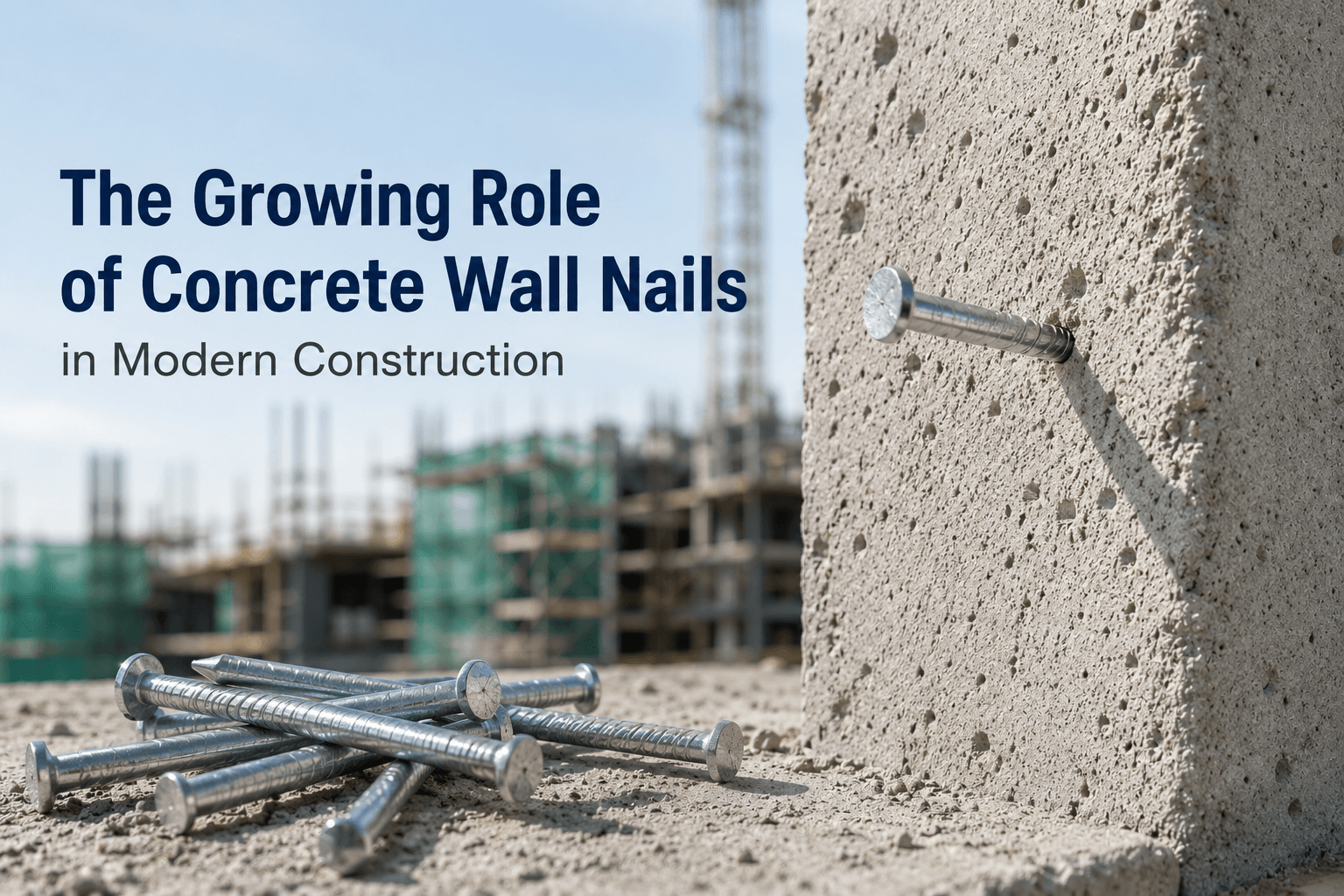
The Growing Role of Concrete Wall Nails in Modern Construction
Modern construction is moving toward faster installation, stronger wall systems, and lower labor costs. As concrete structures, block walls, and prefabricated building systems become more common, efficient wall fastening solutions are becoming a key part of construction quality.
Products such as nail for cement wall, nail on concrete wall, and nails for block walls are no longer simple accessories. They directly affect installation speed, wall stability, and long-term project performance.

Concrete wall nails play an essential role in modern construction because they provide fast, strong, and reliable fastening for concrete walls, brick walls, and block walls. Compared with traditional fastening methods, hardened concrete nails improve installation efficiency, reduce labor time, and enhance wall stability. High-quality galvanized concrete nails also offer better corrosion resistance for outdoor and humid construction environments.
Why Modern Construction Depends More on Wall Fastening Systems
In modern building projects, contractors are under pressure to complete work faster while maintaining consistent quality. Industry reports show that modular and prefabricated construction methods can reduce project schedules by around 20% to 50% compared with traditional construction methods.
This shift increases the need for fastening products that are quick to install, stable under pressure, and suitable for different wall materials.
Modern wall systems often include:
- Concrete walls
- Concrete block walls
- Drywall partition systems
- Lightweight steel framing
- Prefabricated wall panels
- Exterior insulation systems
These systems require reliable fixing for metal tracks, wooden strips, electrical conduits, pipe brackets, ceiling supports, and wall panels. A proper nail on concrete wall can reduce drilling work and improve installation efficiency.
Concrete Nails vs Traditional Fastening Methods
| Item | Concrete Wall Nails | Plastic Anchors / Screws | Ordinary Steel Nails |
|---|---|---|---|
| Installation Speed | Fast | Slower, requires drilling | Fast but unstable on concrete |
| Suitable Wall Type | Concrete, brick, block walls | Concrete and masonry | Mainly wood |
| Holding Stability | High | High, but slower installation | Low on hard walls |
| Labor Cost | Lower | Higher | Low but high failure risk |
| Outdoor Use | Good with galvanized finish | Depends on material | Not recommended |
Why Concrete Wall Nails Have Become a Key Construction Accessory
Concrete and block walls are much harder than wood. Ordinary nails often bend, break, or fail to provide stable holding power. Professional concrete nails are usually made from high-carbon steel and processed through heat treatment and quenching to improve hardness and penetration strength.
In dense wall applications, hardened concrete nails can improve installation efficiency by more than 30% compared with ordinary steel nails. For large construction projects, this difference can save significant labor time.
For example, if a project has 20,000 fastening points, saving only 10 seconds per point can reduce total labor time by more than 55 working hours.

Applications of Concrete Nails in Different Building Projects
Residential Construction
In residential buildings, concrete wall nails are used for wood strip fixing, ceiling installation, interior decoration, wall panel mounting, and floor edge fastening.
Commercial Buildings
In office buildings, shopping centers, warehouses, and industrial facilities, concrete nails are commonly used for electrical cable fixing, pipe support installation, metal framing, suspended ceilings, and HVAC support systems.
Outdoor and Infrastructure Projects
Outdoor projects face moisture, rain, temperature changes, and corrosion risks. This is why galvanized concrete nails are widely used for exterior walls, fencing, temporary structures, agricultural buildings, and infrastructure construction.
Galvanized Concrete Nails vs Black Concrete Nails
| Feature | Galvanized Concrete Nails | Black Concrete Nails |
|---|---|---|
| Surface Treatment | Zinc coated | Black finish |
| Corrosion Resistance | Better | Basic |
| Best Use | Outdoor, humid, coastal projects | Indoor and dry environments |
| Service Life | Longer | Shorter in wet conditions |
Why Concrete Nail Quality Matters
Poor-quality nails can bend during installation, crack the wall surface, reduce holding power, and increase rework costs. In large construction projects, rework may account for around 5% of total construction cost.
That is why professional buyers should not only compare price. They should also check raw material, hardness, surface treatment, packaging strength, and factory quality control.
Key quality factors include:
- High-carbon steel material
- Stable hardness after heat treatment
- Good toughness to reduce breakage
- Sharp point for better penetration
- Consistent shank diameter
- Reliable galvanized coating for outdoor use


