


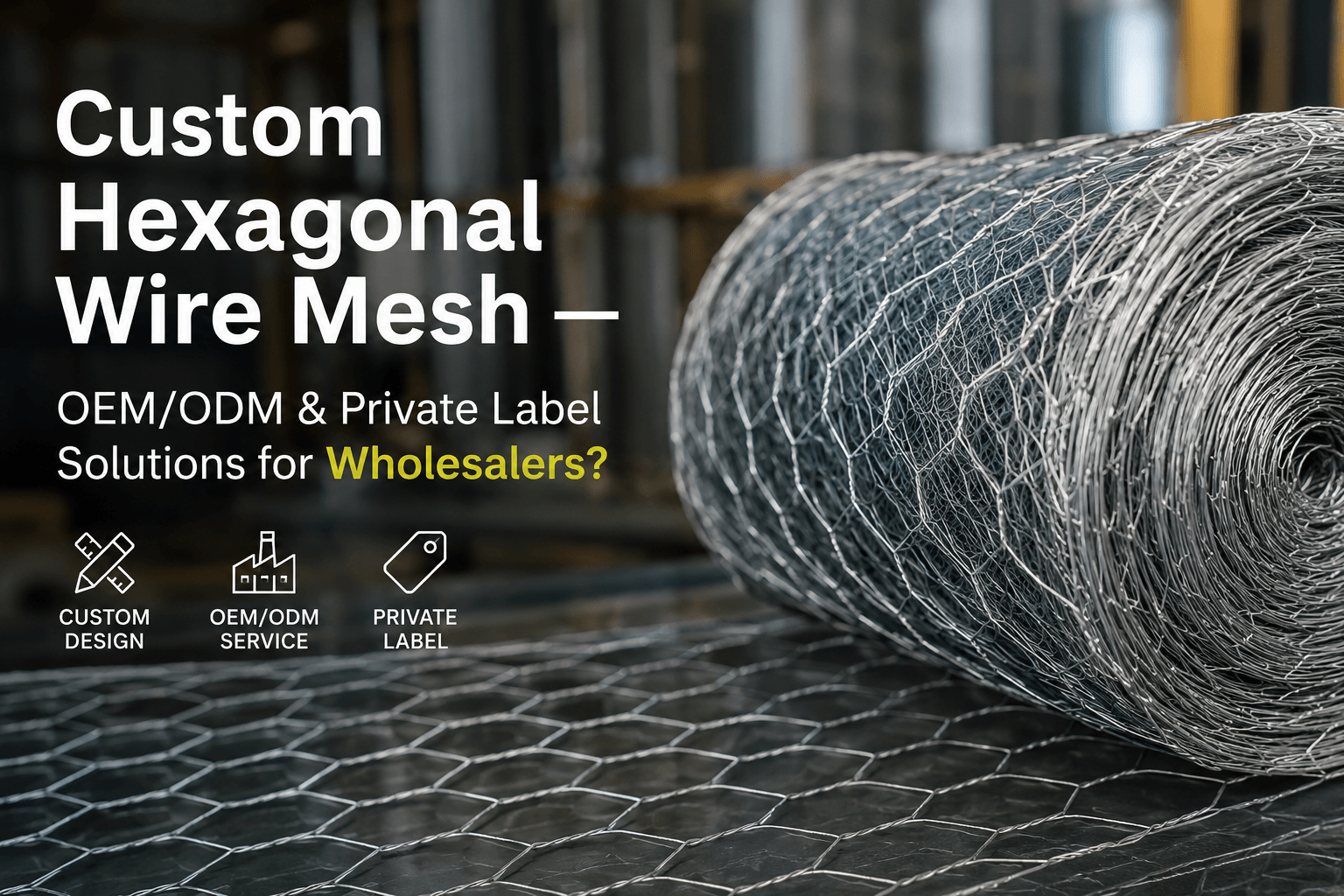
Custom Hexagonal Wire Mesh — OEM/ODM & Private Label Solutions for Wholesalers?
Every wholesaler faces the same problem: finding reliable suppliers who can customize products with your brand. Most manufacturers refuse small orders or charge extra fees for custom packaging.
Custom hexagonal wire mesh OEM services allow wholesalers to order branded chicken wire, rabbit fencing, and garden mesh with their own logos, packaging, and specifications. Professional manufacturers like China Best Hardware offer 5-ton minimum orders with complete customization including wire diameter, mesh size, coating type, and private label packaging.

I've been working with wholesalers for over 15 years, and I understand your biggest challenge. You need products that stand out on retail shelves while maintaining competitive pricing. Let me share everything you need to know about custom hexagonal wire mesh solutions.
What Is Custom Hexagonal Wire Mesh OEM?
Finding a manufacturer who truly understands your branding needs feels impossible. Most suppliers treat customization as an afterthought.
Custom hexagonal wire mesh OEM means a manufacturer produces chicken wire, rabbit fencing, and garden mesh according to your exact specifications, including your brand name, logo, packaging design, and product dimensions. The manufacturer handles everything from raw materials to finished packaging while you maintain complete brand control.

OEM manufacturing goes far beyond simple logo printing. I work with clients who need specific wire diameters for different applications. A chicken coop requires 20-gauge wire, while rabbit hutches work better with 19-gauge material. Garden fencing needs different mesh openings than poultry wire.
The process starts with your specifications. You tell me the exact wire diameter, mesh opening size, roll width, roll length, and coating type. Then I handle the technical details. My factory adjusts the hexagonal weaving machines to create your exact mesh pattern. We control the galvanization process to meet your corrosion resistance requirements.
Quality control happens at every step. We test wire tensile strength, measure mesh opening accuracy, and verify coating thickness. Each roll gets inspected before packaging. Your brand reputation depends on consistent quality, so I never compromise on manufacturing standards.
| OEM Service | What We Provide | Your Benefit |
|---|---|---|
| Product Design | Custom wire diameter and mesh size | Perfect fit for your market |
| Brand Integration | Your logo on packaging and tags | Complete brand control |
| Quality Control | Testing at every production stage | Consistent product quality |
| Packaging Design | Custom boxes, labels, and inserts | Retail-ready presentation |
What Is Hexagonal Wire Mesh Used For?
Your customers buy hexagonal wire mesh for dozens of different applications. Each use requires specific wire thickness and mesh opening sizes.
Hexagonal wire mesh serves multiple purposes including chicken coops, rabbit hutches, garden fencing, erosion control, and craft projects. Poultry applications need 1-inch mesh openings with 20-gauge wire, while garden protection requires 1/2-inch openings with 19-gauge wire for better small animal deterrence.

I see three main customer categories in my business. Poultry farmers need sturdy wire that keeps chickens in and predators out. They want 1-inch mesh with heavy-gauge wire. Garden enthusiasts prefer smaller mesh openings to stop rabbits and groundhogs. Craft makers choose fine mesh for art projects and home decoration.
Construction contractors use hexagonal mesh for concrete reinforcement and stucco backing. The hexagonal pattern distributes stress better than square mesh. Landscapers install it for slope stabilization and retaining wall backing. Marine applications require heavily galvanized wire for salt water resistance.
Each application demands different specifications. Chicken wire needs flexibility for easy installation around curved coop frames. Rabbit fencing requires smaller openings to prevent escapes. Garden borders need attractive appearance plus functionality. Industrial uses prioritize strength over appearance.
Understanding these applications helps you stock the right products. I recommend offering three standard sizes: 1/2-inch mesh for gardens, 1-inch mesh for poultry, and 2-inch mesh for general fencing. This covers 80% of customer needs while keeping inventory manageable.
| Application | Mesh Opening | Wire Gauge | Special Requirements |
|---|---|---|---|
| Chicken Coops | 1 inch | 20 gauge | Flexible installation |
| Rabbit Hutches | 1/2 inch | 19 gauge | Small opening security |
| Garden Fencing | 1/2 inch | 20 gauge | Attractive appearance |
| Craft Projects | 1/4 inch | 22 gauge | Fine detail work |
| Construction | 2 inch | 16 gauge | High tensile strength |
Can I Order Private Label Chicken Wire?
Every retailer wants their own branded packaging, but most suppliers make it complicated and expensive. The process should be simple and affordable.
Private label chicken wire allows retailers to sell hexagonal wire mesh under their own brand name with custom packaging, labels, and product information. Professional manufacturers provide complete branding services including package design, logo placement, UPC codes, and retail-ready presentation starting from 5-ton minimum orders.

Private labeling transforms commodity wire mesh into a branded product. I help clients develop packaging that stands out on retail shelves. Your brand logo goes on the packaging, not mine. Product information reflects your company details. UPC codes link to your inventory system.
The packaging process starts with design consultation. I review your brand guidelines and suggest packaging options. Cardboard sleeves work well for small rolls. Plastic shrink wrap suits larger rolls. Wooden spools add premium appeal for craft applications. Each option affects your final cost and shelf presentation.
Labeling includes all required information. Product specifications, safety warnings, and installation instructions appear in your chosen language. I can include multiple languages for international markets. QR codes link to your website for additional product information and customer support.
Quality control extends to packaging. Each package gets inspected for print quality, label placement, and overall appearance. Damaged packaging gets rejected before shipping. Your brand image depends on perfect presentation, so I maintain strict packaging standards.
| Private Label Element | Options Available | Timeline |
|---|---|---|
| Package Design | Custom graphics and colors | 7-10 days |
| Logo Placement | Multiple positions available | 3-5 days |
| Product Labels | Multi-language options | 5-7 days |
| UPC Codes | Your barcode system | 2-3 days |
| Instruction Inserts | Custom installation guides | 7-10 days |
What Custom Packaging Options Are Available?
Standard packaging rarely fits your specific market needs. Different customers prefer different presentation styles and package sizes.
Custom packaging options for hexagonal wire mesh include cardboard sleeves, plastic shrink wrap, wooden spools, display boxes, and bulk packaging. Each option serves different retail environments from hardware stores to garden centers, with pricing and minimum quantities varying by packaging type.

Packaging choice affects your profit margins and customer appeal. Cardboard sleeves cost less but offer limited protection. Plastic shrink wrap provides weather resistance for outdoor storage. Wooden spools appeal to craft customers who value presentation. Display boxes work well for impulse purchases near checkout counters.
I offer five main packaging categories. Basic shrink wrap suits price-conscious customers. Premium cardboard boxes appeal to garden centers. Wooden spools target craft stores. Display-ready packages work for big box retailers. Bulk packaging serves contractors and large-scale users.
Each packaging type has different minimum quantities. Shrink wrap starts at 100 pieces. Custom printed boxes require 500 pieces minimum. Wooden spools need 200 pieces for cost efficiency. Display packages work with 300 pieces. Bulk packaging has no minimums but offers less customization.
Environmental considerations matter to many customers. I offer recyclable cardboard options and biodegradable plastic wrap. These eco-friendly choices cost slightly more but appeal to environmentally conscious buyers. Many retailers now require sustainable packaging for their private label products.
Storage and shipping affect packaging choice. Cardboard boxes stack efficiently but add weight. Shrink-wrapped rolls pack tightly but may shift during transport. Wooden spools look attractive but increase shipping costs. Consider your warehouse space and shipping methods when choosing packaging.
| Packaging Type | Best For | Minimum Quantity | Cost Level |
|---|---|---|---|
| Shrink Wrap | Price-conscious markets | 100 pieces | Low |
| Cardboard Sleeves | General retail | 300 pieces | Medium |
| Premium Boxes | Garden centers | 500 pieces | High |
| Wooden Spools | Craft stores | 200 pieces | High |
| Display Boxes | Impulse purchases | 300 pieces | Medium |
Can Wire Diameter and Mesh Size Be Customized?
Standard mesh sizes don't always match your customers' specific needs. Different applications require precise wire thickness and opening dimensions.
Wire diameter and mesh size can be fully customized for hexagonal wire mesh, ranging from 14-gauge to 23-gauge wire with mesh openings from 1/4 inch to 4 inches. Custom specifications require engineering review to ensure structural integrity and manufacturing feasibility, with 5-ton minimum orders for non-standard sizes.
Wire diameter affects strength, flexibility, and cost. Heavier gauge wire costs more but provides better durability. Lighter gauge wire installs easier but may not withstand harsh conditions. I help customers balance these factors based on their intended applications.
Mesh opening size determines what the wire can contain or exclude. Smaller openings cost more due to increased material usage and slower production speeds. Larger openings use less material but may not provide adequate security for some applications. The relationship between wire gauge and mesh opening affects overall product performance.
Manufacturing constraints limit some combinations. Very thin wire cannot support large mesh openings. Very thick wire becomes difficult to weave into small openings. My engineering team reviews each custom specification to ensure the combination will produce a functional product.
Testing verifies custom specifications meet performance requirements. We measure tensile strength, flexibility, and durability for each custom combination. Load testing ensures the mesh can handle expected stress levels. Environmental testing confirms coating adhesion and corrosion resistance.
Production setup costs affect pricing for custom sizes. Standard sizes run on pre-configured equipment. Custom sizes require machine adjustments and tool changes. These setup costs spread across larger orders, making 5-ton minimums necessary for cost-effective custom production.
| Wire Gauge | Diameter (mm) | Suitable Mesh Sizes | Best Applications |
|---|---|---|---|
| 14 gauge | 2.0mm | 2-4 inches | Heavy construction |
| 16 gauge | 1.6mm | 1-3 inches | Farm fencing |
| 19 gauge | 1.0mm | 1/2-2 inches | Garden protection |
| 20 gauge | 0.9mm | 1/2-1 inch | Poultry enclosures |
| 23 gauge | 0.6mm | 1/4-1/2 inch | Craft applications |
Is Galvanized or PVC Coated Wire Mesh Better?
Choosing the right coating affects product lifespan, appearance, and customer satisfaction. Each coating type serves different environments and applications.
Galvanized wire mesh provides superior corrosion resistance and costs less than PVC coating, making it ideal for outdoor applications and humid environments. PVC coated mesh offers color options and smoother surfaces but costs 15-20% more and may crack in extreme temperatures, making galvanized wire the better choice for most commercial applications.

Galvanized coating protects wire through sacrificial corrosion. The zinc layer corrodes first, protecting the underlying steel. This process continues for years, providing long-term protection. Hot-dip galvanizing offers better protection than electro-galvanizing but costs slightly more. The thick zinc coating resists scratches and maintains protection even if damaged.
PVC coating provides color options and smooth surfaces. Green PVC blends with garden environments. Black PVC offers subtle appearance for architectural applications. White PVC suits indoor or decorative uses. The plastic coating prevents direct metal contact with skin, making it comfortable for handling.
Environmental factors determine the best choice. Marine environments require heavy galvanizing due to salt exposure. Urban areas with air pollution benefit from PVC protection. Agricultural settings with fertilizer exposure need galvanized wire. Residential gardens can use either coating based on aesthetic preferences.
Cost analysis shows galvanized wire offers better value. Initial costs are lower, and lifespan typically exceeds PVC coated wire. PVC coating may crack or peel over time, exposing the underlying wire to corrosion. Galvanized coating gradually wears away but provides protection throughout its life.
Temperature extremes affect PVC coating performance. Cold weather makes PVC brittle and prone to cracking. Hot weather can cause PVC to soften and become sticky. Galvanized coating performs consistently across all temperature ranges, making it more reliable for diverse climates.
| Coating Type | Corrosion Resistance | Cost | Temperature Range | Best Applications |
|---|---|---|---|---|
| Hot-Dip Galvanized | Excellent | Low | -40°F to 200°F | Marine, agricultural |
| Electro-Galvanized | Good | Low | -20°F to 150°F | General outdoor use |
| PVC Coated | Fair | High | 10°F to 140°F | Decorative, indoor |
| Powder Coated | Good | Medium | -10°F to 180°F | Architectural |
What Is the MOQ for Custom Orders?
Small businesses often struggle with high minimum order quantities that tie up cash flow and warehouse space. Finding flexible suppliers becomes critical for business success.
Minimum order quantity for custom hexagonal wire mesh starts at 5 metric tons for private label packaging and 2 metric tons for standard products with custom specifications. Mixed container loads allow combining different mesh sizes and coatings to reach minimum quantities while reducing inventory investment.

MOQ requirements balance production efficiency with customer needs. Custom packaging requires printing setup costs that spread across larger quantities. Custom wire specifications need machine adjustments that justify minimum production runs. These fixed costs make small orders uneconomical for both manufacturer and customer.
Mixed loading reduces the impact of minimum quantities. You can combine different mesh sizes in one container. Half-inch and one-inch mesh can ship together. Different coating types can share container space. This flexibility helps new customers test multiple products without massive inventory investment.
Container optimization affects total costs. Full container loads (FCL) offer better per-unit pricing than less-than-container loads (LCL). A 20-foot container holds approximately 18-20 tons of wire mesh. A 40-foot container accommodates 25-28 tons. Understanding these capacities helps plan efficient orders.
Payment terms affect MOQ requirements. Larger orders qualify for extended payment terms. Smaller orders typically require faster payment. Letter of credit arrangements may reduce MOQ requirements by providing payment security. Building long-term relationships can lead to more flexible terms.
Seasonal planning helps manage MOQ challenges. Spring garden season drives higher demand. Fall poultry housing projects increase sales. Planning orders around these cycles helps move inventory faster. I work with customers to time production for their peak selling seasons.
| Order Type | Minimum Quantity | Container Type | Payment Terms |
|---|---|---|---|
| Standard Products | 2 metric tons | LCL acceptable | 30% deposit |
| Custom Specifications | 3 metric tons | FCL preferred | 50% deposit |
| Private Label | 5 metric tons | FCL required | Letter of credit |
| Mixed Loading | 2 metric tons | LCL/FCL | Flexible terms |
How Long Does OEM Production Take?
Time-to-market affects your ability to capitalize on seasonal demand and customer opportunities. Understanding production timelines helps plan inventory and marketing campaigns.
OEM hexagonal wire mesh production typically takes 15-25 days from order confirmation to shipping, including 3-5 days for material preparation, 7-10 days for manufacturing, 2-3 days for quality control, and 3-7 days for custom packaging. Rush orders can be accommodated with 15% surcharge for 10-12 day delivery.

Production scheduling depends on current factory capacity and material availability. Standard wire gauges stay in stock, reducing material preparation time. Custom wire diameters require special ordering from steel suppliers, adding 3-5 days. Coating materials like zinc and PVC must be scheduled around other production runs.
Manufacturing time varies by product complexity. Standard hexagonal mesh produces quickly on automated equipment. Custom mesh sizes require machine setup and adjustment time. Quality control testing happens throughout production but adds time for custom specifications. Each batch gets tested for wire diameter accuracy, mesh opening consistency, and coating adherence.
Packaging significantly affects timeline. Standard shrink wrap packaging happens quickly during production. Custom printed packaging requires coordination with printing suppliers. Complex packaging with multiple components needs assembly time. Quality control of packaging adds inspection time but prevents customer complaints.
Shipping preparation includes documentation, container loading, and customs paperwork. Export documentation requires 1-2 days for preparation. Container booking depends on shipping line availability. Peak seasons may extend shipping schedules. I coordinate all logistics to minimize delays.
Rush production accommodates urgent customer needs. Priority scheduling moves orders ahead in production queue. Overtime shifts can compress manufacturing time. Air freight shipping reduces transit time but increases costs significantly. Rush surcharges cover the additional coordination and expedited handling.
| Production Phase | Standard Timeline | Rush Timeline | Key Factors |
|---|---|---|---|
| Material Prep | 3-5 days | 1-2 days | Stock availability |
| Manufacturing | 7-10 days | 5-7 days | Machine capacity |
| Quality Control | 2-3 days | 1-2 days | Testing complexity |
| Custom Packaging | 3-7 days | 2-3 days | Printing schedules |
| Shipping Prep | 2-3 days | 1-2 days | Documentation |
Why Choose China Best Hardware as Your OEM Manufacturer?
Selecting the right OEM partner affects your business success for years. The wrong choice leads to quality problems, delivery delays, and customer complaints.
China Best Hardware offers dual manufacturing facilities in China and Ethiopia, 15-year industry experience, 5-ton minimum orders, complete customization capabilities, and preferential trade advantages through COMESA and AfCFTA agreements. Our integrated production includes wire drawing, mesh weaving, galvanizing, and packaging under one roof for quality control and cost efficiency.

My dual facility strategy provides unique advantages. The China facility handles complex custom orders requiring advanced equipment. The Ethiopia facility offers trade preference access to African and Middle Eastern markets. This geographic flexibility helps customers avoid trade barriers and reduce import duties.
Integrated production controls quality and costs. I draw wire from steel rod in my own facility. Mesh weaving happens on modern automated equipment. Hot-dip galvanizing uses my own zinc bath for consistent coating thickness. Custom packaging occurs in clean, controlled environments. This vertical integration eliminates quality variations from multiple suppliers.
Experience matters in OEM manufacturing. I've worked with over 500 customers across 40 countries. This exposure teaches me what works in different markets. European customers prefer certain packaging styles. American retailers need specific UPC code formats. Middle Eastern buyers focus on different quality aspects. This knowledge helps optimize products for your target market.
Quality systems ensure consistent production. ISO 9001 certification governs all processes. Incoming material inspection prevents defective raw materials from entering production. In-process monitoring catches problems early. Final inspection confirms specifications before packaging. Third-party testing validates quality claims for customer confidence.
Customer service extends beyond manufacturing. Technical support helps optimize product specifications. Logistics coordination simplifies shipping arrangements. After-sales support resolves any issues quickly. Long-term partnerships develop through consistent service and quality delivery.
Trade advantages reduce your costs. COMESA membership provides duty-free access to 21 African countries. AfCFTA agreements expand preferential access across Africa. These savings can be passed to your customers or improve your profit margins. Many competitors cannot offer these trade benefits.
| Advantage | Benefit to You | Supporting Evidence |
|---|---|---|
| Dual Facilities | Trade barrier avoidance | China + Ethiopia locations |
| Integrated Production | Quality control | Wire to packaging in-house |
| Experience | Market knowledge | 500+ customers, 40 countries |
| Quality Systems | Consistent products | ISO 9001 certification |
| Trade Preferences | Cost savings | COMESA, AfCFTA membership |
| Customer Service | Partnership support | 15+ year relationships |
Conclusion
Custom hexagonal wire mesh OEM services transform commodity products into branded solutions that build customer loyalty and improve profit margins for wholesale businesses.


