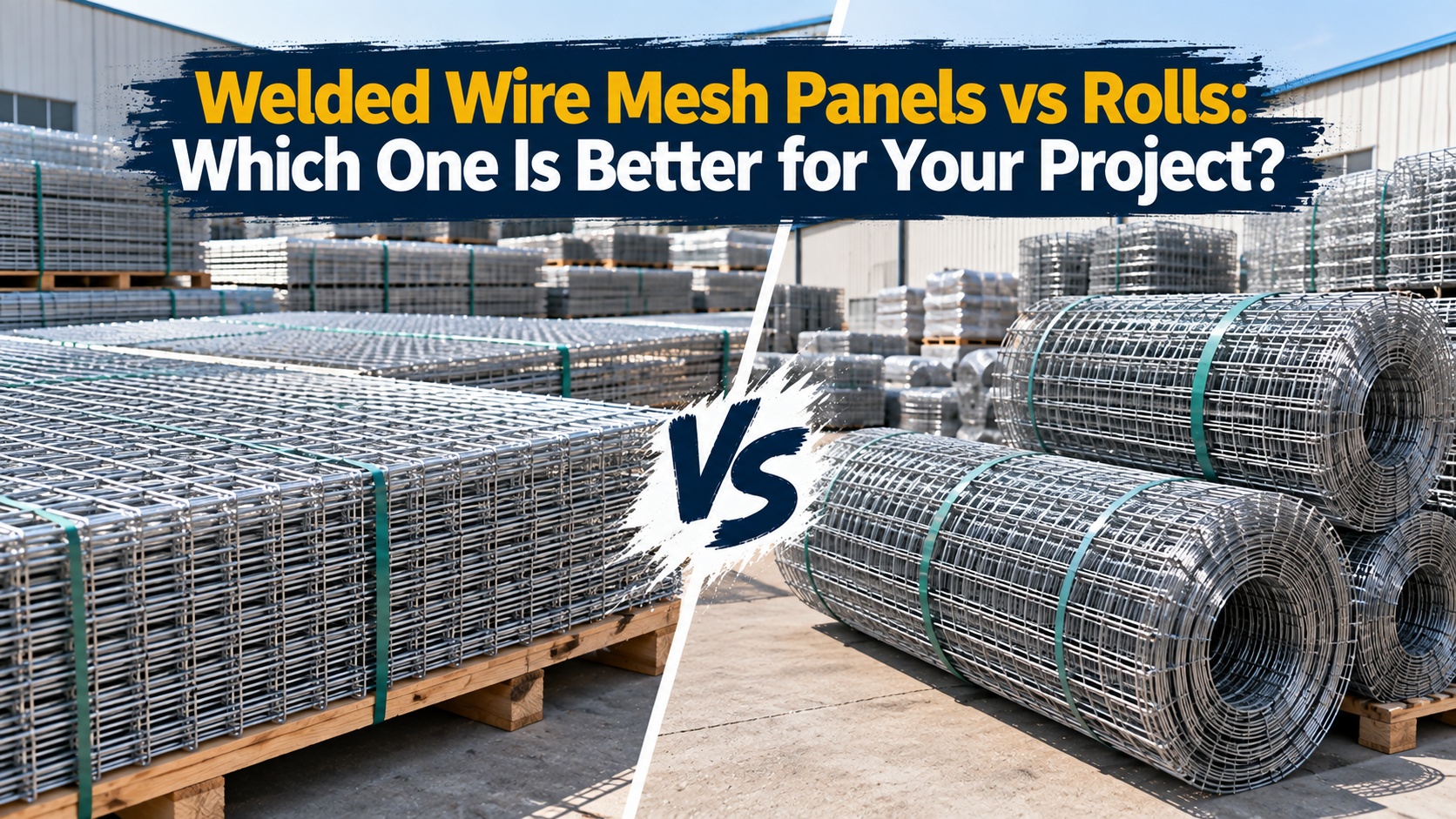


Welded Wire Mesh vs Woven & Hexagonal Wire Mesh: Which One Should You Choose?
Welded wire mesh, woven wire mesh, and hexagonal wire mesh may look similar at first glance, but they are manufactured differently and provide very different levels of strength, rigidity, flexibility, and installation performance.
Welded wire mesh is generally preferred for applications requiring rigidity and structural stability. Woven mesh provides a balance between strength and flexibility, while hexagonal mesh is especially useful for flexible fencing and agricultural applications.

Choosing the correct type depends on the project requirements rather than simply selecting the lowest-priced mesh. Buyers should consider strength, terrain, installation method, service environment, maintenance, and total project cost.
What Is the Difference Between Welded, Woven, and Hexagonal Wire Mesh?
The biggest difference between these three products is how the individual wires are connected.
Welded Wire Mesh
Perpendicular wires are joined together at each intersection through resistance welding, creating a rigid and dimensionally stable grid.
Woven Wire Mesh
Individual wires pass over and under one another in a woven pattern, producing a mesh with greater flexibility than welded construction.
Hexagonal Wire Mesh
Wires are twisted together to form six-sided openings. This construction produces a lightweight and flexible mesh commonly known as chicken wire.

Welded Wire Mesh Construction
Welded wire mesh uses intersecting longitudinal and transverse wires joined at their crossing points. Because the intersections are fixed, the openings remain relatively stable under normal handling and installation.
| Specification | Typical Range in Source Article |
|---|---|
| Wire Diameter | 2–8 mm |
| Mesh Size | 6 × 6 mm to 200 × 200 mm |
| Panel Size | 1 × 2 m to 2.5 × 6 m |
| Material | Low-carbon steel or stainless steel |
Woven Wire Mesh Construction
Woven mesh is manufactured in a similar principle to fabric. Wires are interlaced in an over-under pattern, which allows some movement between intersections.
Depending on the application, woven mesh may use plain weave, crimped wire, or other weaving configurations to achieve different balances of strength and flexibility.
Hexagonal Wire Mesh Construction
Hexagonal mesh uses twisted-wire connections rather than welded or woven intersections. The resulting six-sided pattern can bend and conform to uneven surfaces more easily.
This flexibility makes it particularly useful for poultry fencing, garden protection, lightweight agricultural barriers, slopes, and temporary installations.
Which Wire Mesh Is Stronger?
Strength cannot be determined from the mesh category alone. Wire material, diameter, opening size, manufacturing quality, coating, and installation method all influence actual performance.
As a general selection principle, welded mesh offers the greatest rigidity, woven mesh provides a balance of strength and flexibility, and hexagonal mesh prioritizes flexibility over structural rigidity.

Welded Mesh
Fixed welded intersections help the mesh retain its geometry and transfer loads across the grid. This makes welded mesh suitable for many structural, security, cage, partition, and reinforcement applications.
Woven Mesh
Woven construction allows controlled movement between wires. This makes the product less rigid than welded mesh but often more suitable for applications requiring impact absorption or conformity to a surface.
Hexagonal Mesh
Hexagonal mesh is designed primarily for flexibility and material efficiency. The twisted structure can deform without immediately losing the entire mesh pattern, but it should not be treated as a substitute for rigid structural reinforcement.
Technical Note: Published strength values should always be evaluated against the exact wire diameter, steel grade, opening size, joint construction, and relevant test method rather than being applied to an entire mesh category.
Why Is Hexagonal Wire Mesh Suitable for Agriculture?
Agricultural fencing often needs to follow uneven land rather than maintain a perfectly rigid plane. This is where hexagonal mesh provides a practical advantage.
Hexagonal wire mesh can conform to slopes, curves, dips, and irregular ground more easily than rigid welded panels.

Terrain Adaptability
The flexible mesh can follow ground contours without requiring the same level of surface preparation that rigid panels may need.
Animal Containment
Different opening sizes can be selected according to animal size. Smaller openings are useful for small poultry or rabbits, while larger openings may be suitable for general garden and agricultural applications.
Typical Agricultural Selection Guide
| Application | Typical Mesh Size | Typical Wire Gauge | Main Benefit |
|---|---|---|---|
| Chicken Coops | Approx. 25 mm | Approx. 20 Gauge | Small-animal containment |
| Rabbit Hutches | Approx. 13 mm | Approx. 19 Gauge | Smaller opening size |
| Garden Protection | Approx. 50 mm | Approx. 18 Gauge | Pest control and flexibility |
| Temporary Fencing | Approx. 75 mm | Approx. 16 Gauge | Fast installation |
Application Note: Animal containment should be specified according to actual animal size, pressure against the fence, predator risks, fence height, and required service life.
How Do Cost, Installation, and Durability Compare?
Purchase price is only one part of the comparison. Buyers should also consider installation labor, support structure, maintenance, repair, and replacement requirements.

General Comparison
| Factor | Welded Mesh | Woven Mesh | Hexagonal Mesh |
|---|---|---|---|
| Rigidity | High | Medium | Low |
| Flexibility | Low | High | Very High |
| Installation on Uneven Ground | More difficult | Moderate | Easy |
| Structural Applications | Very suitable | Application dependent | Generally unsuitable |
| Agricultural Use | Suitable | Suitable | Highly suitable |
| Typical Relative Cost | Higher | Medium | Lower |
Welded Wire Mesh Installation
Welded mesh generally requires more accurate support alignment because the material is rigid and less able to accommodate uneven posts or surfaces.
Once installed correctly, however, its dimensional stability can reduce the need for frequent tension adjustment.
Woven Wire Mesh Installation
Woven mesh offers greater tolerance for irregular conditions than welded panels, but installation often requires proper tensioning to maintain the desired shape.
Hexagonal Mesh Installation
Hexagonal mesh is lightweight and flexible, which can simplify handling and installation around slopes, curved areas, gardens, and poultry enclosures.
How Does Durability Compare?
Service life depends heavily on material, wire diameter, coating quality, corrosion environment, installation, and maintenance.
- Welded mesh: rigid intersections provide excellent dimensional stability.
- Woven mesh: flexible intersections may allow easier localized repair.
- Hexagonal mesh: economical and easy to replace, but lighter specifications can be more vulnerable to mechanical damage.
Buyer Note: Avoid comparing lifespan using mesh type alone. A heavily galvanized hexagonal mesh can outperform a poorly coated welded mesh in some environments. Coating quality and specification matter significantly.
How Do You Choose the Right Wire Mesh?
The best mesh depends on what the project requires most: rigidity, flexibility, security, easy installation, low material cost, or long-term durability.

- Define the Application
Determine whether the mesh is needed for reinforcement, security, agriculture, screening, garden use, cages, or temporary fencing. - Determine Required Strength
Structural or high-security applications normally require greater rigidity than light agricultural fencing. - Evaluate the Terrain
Slopes and irregular surfaces may favor woven or hexagonal mesh. - Consider Installation Method
Evaluate posts, frames, fasteners, tensioning, access, and labor. - Evaluate Corrosion Exposure
Outdoor, coastal, humid, and industrial environments may require heavier galvanizing, PVC coating, or stainless steel. - Compare Total Project Cost
Consider material, support structure, installation, maintenance, and replacement—not only unit price.
Which Mesh Is Best for Different Applications?
| Application | Common Choice | Main Reason |
|---|---|---|
| Concrete Reinforcement | Welded Wire Mesh | Rigid geometry and fixed intersections |
| Security Fencing | Welded Wire Mesh | Rigidity and resistance to deformation |
| Agricultural Fencing | Woven / Hexagonal | Flexibility and terrain adaptability |
| Temporary Barriers | Hexagonal Mesh | Lightweight and easy installation |
| Garden Borders | Woven / Hexagonal | Easy shaping and moderate strength |
| Machine Guards | Welded Wire Mesh | Stable openings and rigid construction |
Quick Comparison: Which One Should You Choose?
Choose Welded Mesh If...
- You need high rigidity
- Opening stability matters
- The installation is permanent
- Security is important
- The application is structural
Choose Woven Mesh If...
- You need flexibility
- Impact absorption matters
- The surface is irregular
- Moderate strength is sufficient
- Local repairs may be required
Choose Hexagonal Mesh If...
- You need maximum flexibility
- The project involves agriculture
- The ground is uneven
- Lightweight handling matters
- Material cost is a major factor
What Should You Tell a Wire Mesh Supplier?
To receive an accurate recommendation and quotation, buyers should provide technical requirements rather than asking only for “wire mesh.”
- Application
- Preferred mesh type
- Wire diameter
- Mesh opening
- Panel or roll dimensions
- Material grade
- Galvanized, PVC-coated, or stainless finish
- Total quantity
- Required standard or testing
- Packaging requirements
- Destination port or delivery location
Conclusion
Welded, woven, and hexagonal wire mesh each serve different purposes. There is no single mesh type that is best for every application.
- Welded wire mesh is generally the best choice when rigidity, dimensional stability, structural performance, or security is the priority.
- Woven wire mesh is useful when a project requires moderate strength combined with greater flexibility.
- Hexagonal wire mesh is particularly suitable for poultry, gardens, temporary fencing, slopes, and other applications where flexibility and economical coverage are important.
For B2B buyers, the safest approach is to compare products using the same wire diameter, opening size, coating, dimensions, and application requirements rather than choosing by mesh type or price alone.