


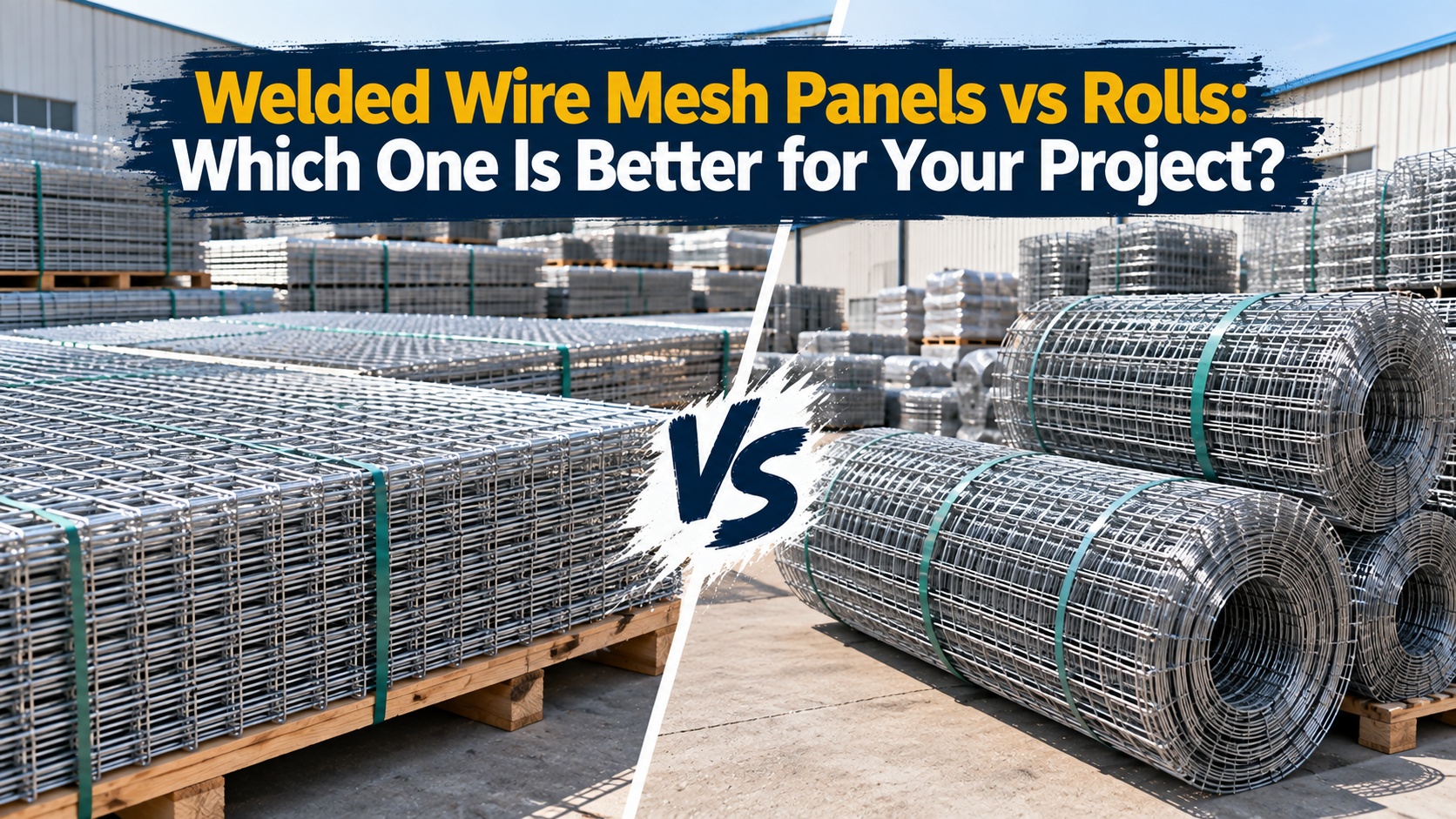
Welded Wire Mesh Panels vs Rolls: Which One Is Better for Your Project?
Choosing between welded wire mesh panels and rolls can directly affect your project timeline, installation cost, transportation requirements, and final appearance. Many contractors spend more than necessary simply because they select the wrong format for the job.
Welded wire mesh panels provide greater rigidity and faster installation for many small and medium projects, while rolls offer flexibility and material cost advantages for large-scale applications. The right choice depends on project size, installation method, labor cost, transportation, and appearance requirements.

After supplying welded wire mesh to contractors in different international markets, Dingzhou Bestar has seen how format selection can influence overall project efficiency. This guide compares welded mesh panels and rolls across strength, installation, cost, shipping, fencing applications, and project size.
What Is the Difference Between Welded Wire Mesh Panels and Rolls?
Welded wire mesh panels and rolls may use the same wire diameter, mesh opening, material, coating, and welding process. The main difference is how the finished mesh is supplied and handled.
Welded Mesh Panels
Pre-cut rectangular sections supplied in fixed dimensions. Panels provide a rigid format that is easier to position and maintain during installation.
Welded Mesh Rolls
Continuous lengths of welded mesh supplied in rolled form. Rolls provide greater flexibility for long runs, irregular areas, and curved installations.

Common Welded Mesh Panel Sizes
| Panel Size | Best Use | Typical Projects |
|---|---|---|
| 4 × 8 ft | Residential fencing | Garden barriers and pet enclosures |
| 6 × 10 ft | Commercial fencing | Construction sites and security areas |
| 8 × 12 ft | Industrial applications | Warehouse partitions and machine guards |
Rolls are supplied in longer continuous lengths and can be cut on site according to the exact dimensions required. This makes them particularly useful for long boundaries and non-standard layouts.
Buyer Note: Panels and rolls can be manufactured with the same wire gauge and mesh opening. The key difference is generally handling, rigidity, installation, packaging, and project suitability rather than the basic wire itself.
Welded Mesh Panels vs Rolls: Which Is Stronger?
Many buyers assume panels are automatically stronger than rolls. In practice, the actual wire strength depends primarily on wire diameter, steel properties, welding quality, and coating rather than whether the product is supplied flat or rolled.
When the wire specification and welding quality are identical, panels and rolls have comparable base wire strength. Panels, however, generally provide better installed rigidity because their flat format helps maintain shape and alignment.

Strength Comparison Factors
| Factor | Panels | Rolls |
|---|---|---|
| Base Wire Strength | Depends on specification | Depends on specification |
| Welding Quality | Depends on manufacturing | Depends on manufacturing |
| Installed Rigidity | Generally high | Depends heavily on tension and support |
| Installation Consistency | Easier to control | More installer dependent |
| Long-Term Alignment | Usually easier to maintain | Requires correct installation tension |
Rolls rely more heavily on proper stretching, tensioning, fastening, and post spacing. Poor installation can result in sagging or uneven lines, while a correctly installed roll system can perform very effectively over long runs.
Which Option Is Easier and Faster to Install?
Installation time can significantly affect the total project cost, especially in markets where skilled labor is expensive.
Panel Installation
Panels arrive in fixed dimensions and can usually be positioned, aligned, and secured directly between posts or frames.
- Less field cutting
- Less tensioning
- Easier alignment
- More consistent final appearance
Roll Installation
Rolls must generally be unrolled, measured, cut, tensioned, and secured during installation.
- Suitable for continuous runs
- Flexible sizing
- Fewer section joints
- More dependent on installer skill

Panels are often faster for repetitive fence sections because the installer does not need to unroll and tension each section. Rolls are more practical where the project contains long continuous runs or irregular dimensions.
Panels vs Rolls: Which Is More Cost-Effective?
Material price alone does not determine the lowest total project cost. Buyers should also consider installation labor, cutting waste, tools, transportation, maintenance, and project duration.
Rolls often have a lower processing and packaging cost per unit area, while panels can reduce field labor and installation complexity. The most economical option depends on local labor rates and total project size.

Cost Factors to Compare
| Cost Factor | Panels | Rolls |
|---|---|---|
| Material Processing | Generally higher | Generally lower |
| Installation Labor | Often lower | Often higher |
| Cutting & Tensioning | Limited | Usually required |
| Tool Requirements | Basic installation tools | May require tensioning and cutting tools |
| Suitability for Long Runs | Moderate | Excellent |
Procurement Tip: Compare the complete installed cost rather than only the supplier's price per square meter or square foot.
Which Is Easier and Cheaper to Transport?
Transportation can become a major purchasing factor for large-volume or international orders.
Panel Transportation
Panels can be stacked in bundles and are relatively straightforward to handle at construction sites, but their flat format may require more loading space.
Roll Transportation
Rolls can provide more compact packaging for some specifications, helping improve container utilization on large-volume orders.

The most efficient shipping format depends on wire diameter, roll diameter, panel dimensions, bundle weight, container size, and unloading equipment. For export orders, buyers should request a container loading plan when comparing panel and roll quotations.
Which Welded Mesh Is Better for Fencing?
Fencing is one of the most common applications where buyers must choose between panels and rolls.
Panels are usually preferred when appearance, straight alignment, installation speed, and rigidity are important. Rolls are commonly preferred for long agricultural or perimeter fencing where flexibility and material efficiency are higher priorities.

Fencing Application Guide
| Fence Type | Typical Choice | Main Reason |
|---|---|---|
| Residential Garden | Panels | Clean appearance and easy installation |
| Commercial Security | Panels | Rigidity and consistent alignment |
| Agricultural Perimeter | Rolls | Suitable for long continuous runs |
| Temporary Construction | Panels | Fast setup and removal |
| Curved Boundaries | Rolls | Greater flexibility |
Post spacing should also be considered. Panels work best when their dimensions match the planned support spacing, while rolls can accommodate a wider range of post distances without requiring custom panel dimensions.
When Is Hexagonal Wire Mesh a Better Choice?
Welded wire mesh is not always the most economical or practical solution. Hexagonal wire mesh, commonly called chicken wire, may be more suitable for light-duty agricultural, garden, and temporary applications.

| Use Case | Welded Mesh | Hexagonal Mesh |
|---|---|---|
| Security Fencing | Highly suitable | Generally unsuitable for high security |
| Garden Protection | Suitable | Highly suitable |
| Concrete Reinforcement | Application dependent | Generally unsuitable |
| Small Animal Enclosures | Suitable | Often suitable |
| Temporary Barriers | Suitable | Often economical and flexible |
Hexagonal mesh is more flexible because of its twisted-wire construction. Welded mesh, on the other hand, provides a more rigid and dimensionally stable grid, making it better suited to applications where shape retention and a professional appearance are important.
How Do You Choose the Right Wire Mesh for Your Project?
There is no single best format for every project. The most appropriate choice depends on your actual installation conditions and purchasing priorities.
- Total Project Size
Determine the total square footage or linear footage required. - Installation Timeline
Evaluate whether installation speed or material cost is the higher priority. - Appearance Requirements
Consider whether straight lines and consistent sections are critical. - Labor Availability
Compare local labor cost and installer skill levels. - Transportation
Compare packaging, container loading, unloading, and local handling. - Future Expansion
Consider whether the fence or installation may need to be extended later.

Quick Decision Matrix
| Project Requirement | Panels May Be Better | Rolls May Be Better |
|---|---|---|
| Fast Installation | ✓ | |
| Professional Appearance | ✓ | |
| Long Continuous Runs | ✓ | |
| Curved Boundaries | ✓ | |
| Lower Field Cutting | ✓ | |
| Flexible Site Dimensions | ✓ |
Conclusion: Panels or Rolls?
The best welded wire mesh format depends on your project size, labor cost, installation speed, transportation requirements, and final appearance.
- Choose welded mesh panels when you need rigidity, consistent appearance, straightforward installation, or clearly defined fence sections.
- Choose welded mesh rolls when you need long continuous lengths, flexible dimensions, curved installation, or improved material efficiency for large areas.
For B2B purchasing, the most reliable approach is to compare the complete installed cost rather than the material price alone.
Request a Welded Wire Mesh Quotation
If you are comparing welded mesh panels and rolls for a wholesale, fencing, agricultural, construction, or industrial project, provide Dingzhou Bestar with the following information:
- Wire diameter
- Mesh opening
- Panel or roll dimensions
- Material
- Galvanizing or coating requirement
- Required quantity
- Application
- Destination port or delivery location
With complete specifications, our team can help compare panel and roll configurations and prepare a quotation based on your project requirements.


