

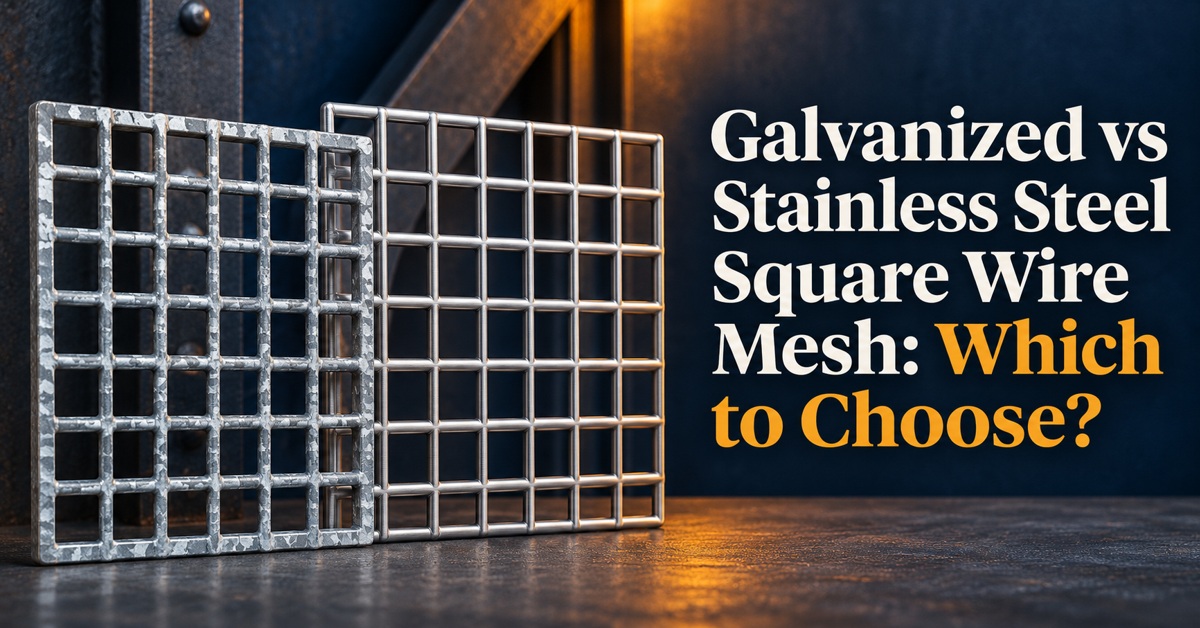
Galvanized vs Stainless Steel Square Wire Mesh: Which to Choose?
Choosing between galvanized and stainless steel wire mesh is mainly a question of corrosion exposure, required service life, application, and total project cost.
Galvanized wire mesh is often a practical and economical choice for general-purpose applications, while stainless steel is commonly selected where corrosion resistance, hygiene, or long-term performance in demanding environments is more important.
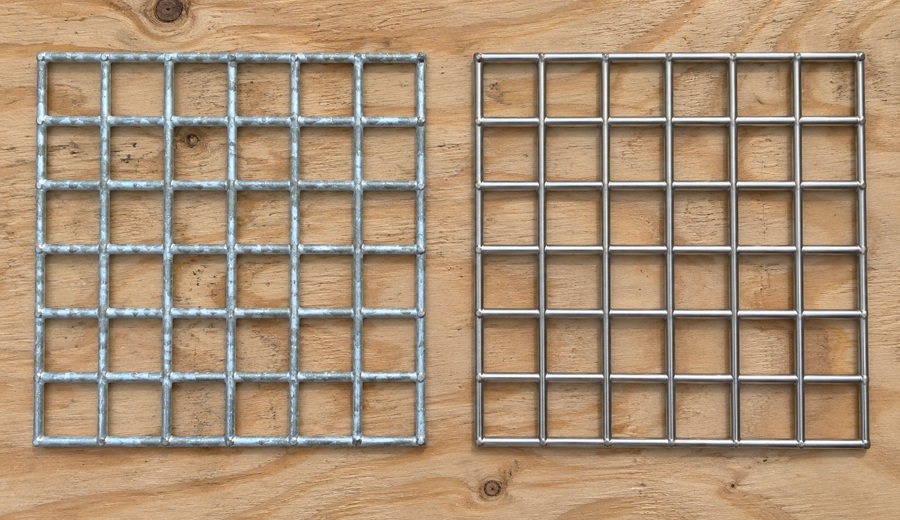
What Is the Difference Between Galvanized and Stainless Steel Wire Mesh?
Galvanized Wire Mesh
Galvanized mesh is typically manufactured from carbon steel wire protected by a zinc coating.
The zinc layer acts as a protective barrier and also provides sacrificial corrosion protection to the underlying steel.
Stainless Steel Wire Mesh
Stainless steel is an alloy containing chromium and other alloying elements. Its corrosion resistance comes from a passive oxide film that forms naturally on the surface.
Different grades, such as 304 and 316, provide different levels of corrosion resistance.

Quick Material Comparison
| Feature | Galvanized Wire Mesh | Stainless Steel Wire Mesh |
|---|---|---|
| Base Material | Typically carbon steel | Stainless steel alloy |
| Corrosion Protection | Zinc coating | Passive chromium-rich surface film |
| Common Options | Electro-galvanized, hot-dip galvanized | 304, 316 and other grades |
| Initial Cost | Generally lower | Generally higher |
| Typical Positioning | General-purpose and cost-sensitive use | Corrosive, hygienic, or demanding environments |
Electro-Galvanized vs Hot-Dip Galvanized Wire Mesh
Not all galvanized mesh provides the same level of corrosion protection. The galvanizing method and actual zinc coating specification matter.
Electro-Galvanized Mesh
Electro-galvanizing deposits zinc on the steel through an electrochemical process and commonly produces a relatively smooth surface.
- Often uses a lighter zinc coating
- Generally economical
- Suitable for many indoor applications
- Can be appropriate for lower-corrosion environments
Hot-Dip Galvanized Mesh
Hot-dip galvanizing involves immersing the steel product in molten zinc. Depending on the specification, this process can provide a heavier zinc coating for outdoor service.
- Commonly used for outdoor fencing
- Agricultural applications
- Construction products
- Humid environments
Procurement Tip: Do not compare galvanized products using “EG” or “HDG” alone. Ask for actual zinc coating mass or coating specification, wire diameter, and relevant manufacturing standard.
Why Is Stainless Steel Corrosion Resistant?
Stainless steel contains enough chromium to form a very thin passive oxide layer on its surface.
This passive film helps protect the underlying metal and can reform when the surface is exposed to oxygen after minor damage.
Technical Note: Stainless steel is corrosion resistant, not universally corrosion-proof. Performance depends on alloy grade, chloride concentration, chemicals, temperature, surface condition, design, contamination, and maintenance.
Which Offers Better Corrosion Resistance?
In mild environments, a properly specified galvanized coating may provide sufficient corrosion protection at a relatively economical cost.
In more aggressive conditions, stainless steel may provide better long-term resistance, particularly where the zinc coating would be consumed rapidly.
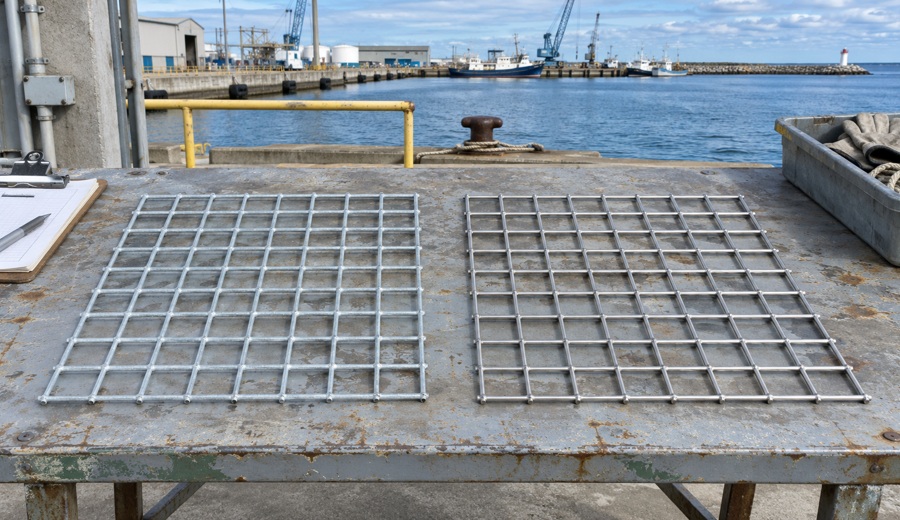
Coastal and Chloride Environments
Salt spray and chloride exposure can accelerate corrosion of galvanized steel and can also challenge some stainless steel grades.
Grade 316 stainless steel contains molybdenum and generally provides improved resistance to chloride-induced pitting compared with grade 304.
For coastal applications, 316 stainless steel is often considered before 304, but the final grade should be selected according to chloride exposure, temperature, cleaning conditions, and project requirements.
Chemical Environments
Chemical compatibility cannot be determined simply by choosing “stainless steel.”
Acids, alkalis, chlorides, cleaning chemicals, temperatures, and concentrations can affect stainless steel grades differently.
Industrial Note: For chemical processing, confirm material compatibility using the specific chemical, concentration, temperature, exposure duration, and stainless steel grade.
How Do Galvanized and Stainless Steel Mesh Compare in Cost?
Galvanized carbon steel generally has a lower initial purchase price than stainless steel.
However, professional purchasing decisions should compare total lifecycle cost rather than upfront price alone.
| Cost Factor | Galvanized Mesh | Stainless Steel Mesh |
|---|---|---|
| Initial Material Cost | Generally lower | Generally higher |
| Coating / Material Cost | Depends on zinc coating | Depends heavily on alloy grade |
| Maintenance | Environment dependent | Often lower in suitable corrosive environments |
| Replacement Frequency | Depends on coating consumption and exposure | Can be lower when the correct grade is selected |
| Lifecycle Value | Strong in mild to moderate environments | Can be advantageous in demanding environments |
Should You Compare Wire Mesh by Lifespan?
Service life is important, but fixed lifespan claims such as “20 years” or “50 years” should be treated cautiously.
Wire mesh lifespan depends on material grade, zinc coating mass, atmospheric corrosivity, salt exposure, chemicals, installation, mechanical damage, maintenance, and local climate.
Two products made from the same nominal material can have very different service lives if the environment or manufacturing specification differs.
Which Material Is Better for Construction?
Galvanized Mesh
- General fencing
- Brick reinforcement products
- Plaster support
- Selected concrete-related mesh products
- Construction barriers
Stainless Steel Mesh
- Corrosive building environments
- Architectural applications
- Food-production facilities
- Specialist industrial buildings
Construction Note: Where mesh is used as structural reinforcement, project drawings, engineering requirements, applicable codes, and specified material properties should govern selection.
Which Material Is Better for Agriculture?
Galvanized mesh is widely used in agricultural fencing and animal enclosures because it can provide a practical balance of cost, strength, and outdoor corrosion resistance.
- Field fencing
- Livestock enclosures
- Poultry mesh
- Garden protection
- Farm partitions
Stainless steel may be considered where hygiene, wash-down conditions, aggressive chemicals, salt exposure, or unusually high corrosion resistance is required.
Which Material Is Better for Industrial Applications?
Industrial environments vary widely, so material selection should be based on the actual process.
Galvanized Mesh May Suit
- General machine guarding
- Warehouse partitions
- Security barriers
- Dry industrial environments
Stainless Steel May Suit
- Food processing
- Pharmaceutical environments
- Wet processing
- Chemical exposure
- High-hygiene applications
304 vs 316 Stainless Steel Wire Mesh
| Feature | 304 Stainless Steel | 316 Stainless Steel |
|---|---|---|
| General Corrosion Resistance | Good | Generally higher |
| Chloride Resistance | More limited | Improved due to molybdenum addition |
| Typical Cost | Lower | Higher |
| Common Use | General industrial and food applications | Marine, coastal, chemical and demanding environments |
Grade Selection: 316 should not automatically be treated as suitable for every chemical or marine application. More aggressive environments may require another stainless alloy or specialist material.
How Do You Choose the Right Wire Mesh Material?
- Assess the Environment
Determine whether the mesh will be indoors, outdoors, exposed to rain, salt spray, chemicals, wash-down procedures, or high humidity. - Define the Required Service Life
Consider whether the installation is temporary, replaceable, or expected to operate for many years with minimal maintenance. - Check Corrosion Severity
Mild environments may suit galvanized steel, while aggressive exposure may justify stainless steel or another corrosion-resistant material. - Compare Lifecycle Cost
Include purchase price, installation, inspection, maintenance, downtime, and replacement—not only initial material cost. - Select the Correct Grade or Coating
For galvanized mesh, confirm zinc coating specifications. For stainless steel, specify the actual alloy grade. - Confirm Application Requirements
Consider hygiene, mechanical load, mesh opening, wire diameter, fabrication, temperature, and relevant industry standards.
Quick Material Selection Guide
| Environment | Typical Option | Main Consideration |
|---|---|---|
| Indoor / Dry | Electro-Galvanized or Other Suitable Carbon Steel Finish | Economical general-purpose use |
| Outdoor / General Weather | Hot-Dip Galvanized | Cost and corrosion protection balance |
| Coastal / Salt Exposure | Often 316 Stainless Steel | Evaluate chloride severity and project requirements |
| Food / Hygiene | Suitable Stainless Steel Grade | Cleanability and compliance requirements |
| Chemical Processing | Material Compatibility Analysis Required | Chemical concentration, temperature and alloy compatibility |
What Information Should You Send to a Supplier?
Wire Mesh Material RFQ Checklist
- Application
- Indoor or outdoor use
- Coastal / chloride exposure
- Chemical exposure if applicable
- Required wire material
- Stainless steel grade if required
- Galvanizing type and zinc coating if required
- Wire diameter
- Mesh opening
- Roll or panel dimensions
- Total quantity
- Required standards or testing
- Packaging requirements
- Destination port or delivery location
WhatsApp: +86 183 3106 1136
Email: info@chinabesthw.com
Conclusion
Galvanized and stainless steel wire mesh both have strong advantages, but they are designed for different purchasing priorities.
Galvanized mesh is often the more economical choice for general construction, agriculture, fencing, and moderate outdoor environments. Stainless steel can provide better lifecycle value where corrosion, hygiene, chlorides, chemicals, or difficult replacement conditions justify the higher material cost.
For professional B2B purchasing, select material based on the actual environment, required service life, corrosion exposure, wire specification, maintenance requirements, and total lifecycle cost—not simply the lowest initial price.