

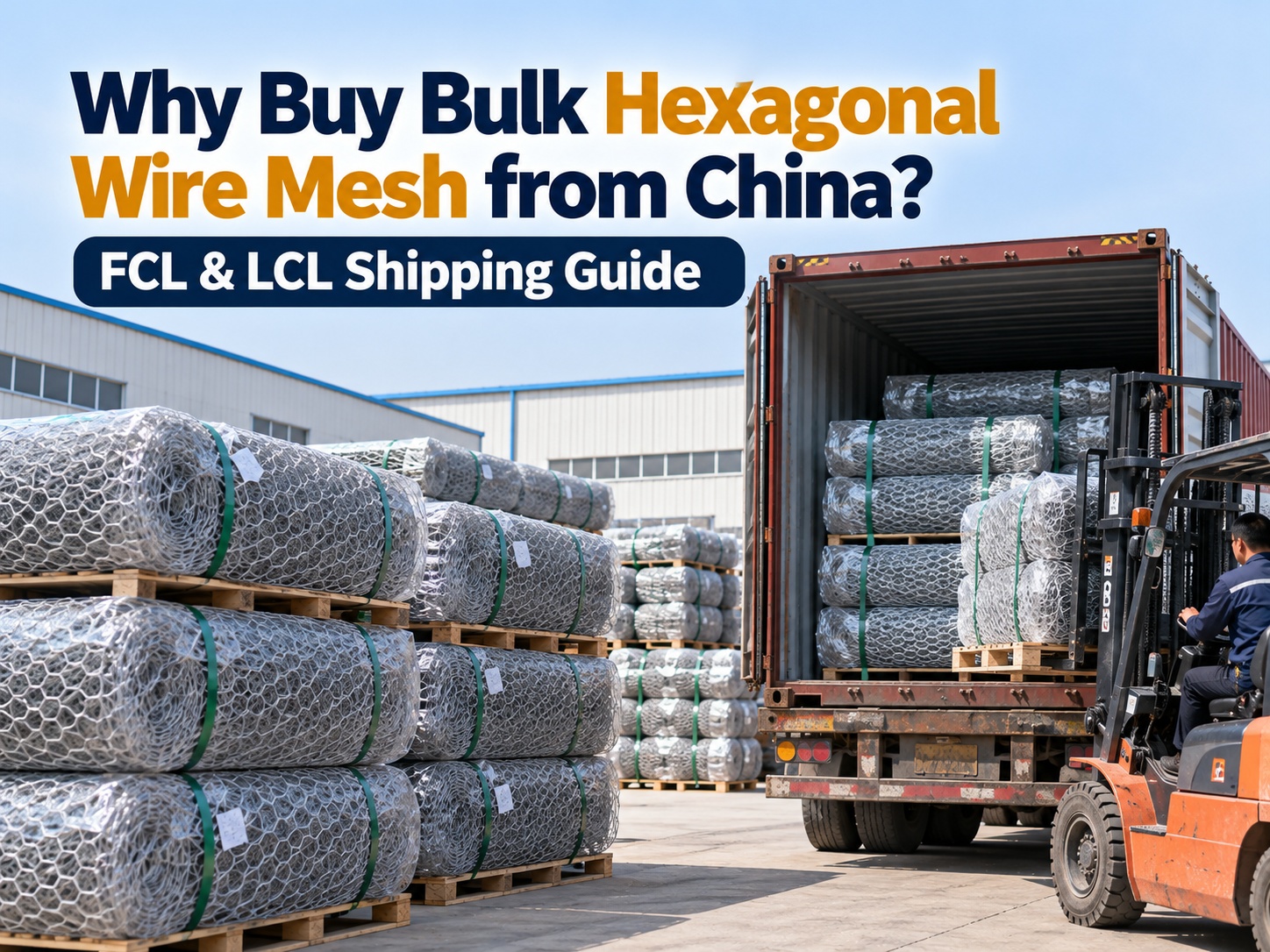
Why Buy Bulk Hexagonal Wire Mesh from China? FCL & LCL Shipping Guide
Buying hexagonal wire mesh in bulk from China can provide competitive sourcing options for fencing, construction, agricultural, and distribution projects. However, product price is only one part of a successful import.
Shipping method, container utilization, packaging, transit time, customs preparation, and supplier reliability can all significantly affect the final landed cost and delivery schedule.
Bulk hexagonal wire mesh can be shipped by FCL or LCL depending on order volume. FCL usually becomes more attractive as shipment volume increases, while LCL gives smaller buyers the flexibility to import partial-container quantities.

What Is the Difference Between FCL and LCL Shipping?
FCL and LCL are the two most common ocean freight methods used for bulk wire mesh imports.
FCL – Full Container Load
The buyer uses an entire shipping container for the shipment. The container is normally loaded for one consignee and travels without being consolidated with unrelated cargo.
LCL – Less than Container Load
The shipment shares container space with cargo from other shippers. Charges are generally based on the cargo volume, weight, and consolidation services required.

Advantages of FCL Shipping
- Entire container dedicated to one shipment
- Fewer cargo handling stages
- Lower risk of mixing with unrelated goods
- Better control over container loading
- Often more economical per ton at higher volumes
- Can simplify handling for large project orders
FCL Shipping Summary
| Factor | FCL Characteristics |
|---|---|
| Cost per Ton | Usually improves as container utilization increases |
| Cargo Handling | Fewer consolidation and deconsolidation stages |
| Damage Risk | Generally lower with proper loading |
| Best Use | Medium to large bulk orders |
Advantages of LCL Shipping
LCL is useful when the buyer does not have enough cargo to justify a full container. Instead of paying for the entire container, the buyer pays for the portion of container space used.
- Suitable for smaller trial orders
- Lower upfront freight commitment
- No need to fill an entire container
- Useful for new supplier evaluations
- Suitable for smaller or irregular purchasing cycles
LCL Note: LCL shipments normally involve additional consolidation, deconsolidation, documentation, and handling. These charges should be included when comparing LCL and FCL quotations.
How Do You Choose Between FCL and LCL?
Order weight is an important factor, but it should not be the only factor. Buyers should compare complete logistics costs for both methods.
The source guide uses approximately 15 tons as a general decision point between LCL and FCL. However, the real break-even point varies by port, freight market, packaging dimensions, destination fees, and season.

Factors to Compare
- Total shipment weight
- Total cubic volume
- Container utilization
- LCL consolidation charges
- Destination deconsolidation fees
- FCL container freight rate
- Project deadline
- Risk of cargo damage
- Destination port capabilities
Indicative Shipping Decision Guide
| Order Size | Typical Approach | Recommended Action |
|---|---|---|
| Under 10 tons | LCL often practical | Compare all consolidation and destination charges |
| 10–15 tons | Borderline range | Request both FCL and LCL freight quotations |
| 15+ tons | FCL often competitive | Calculate container utilization |
| Full-container quantity | FCL | Optimize packing and loading plan |
Importer Tip: Do not choose the shipping method using cargo weight alone. A lightweight mesh may reach the container's volume limit before its weight limit, while heavy wire specifications may reach payload limits first.
How Much Hexagonal Wire Mesh Fits in a Container?
Container loading capacity depends on wire diameter, mesh opening, roll dimensions, packing method, and whether the load reaches its weight or volume limit first.
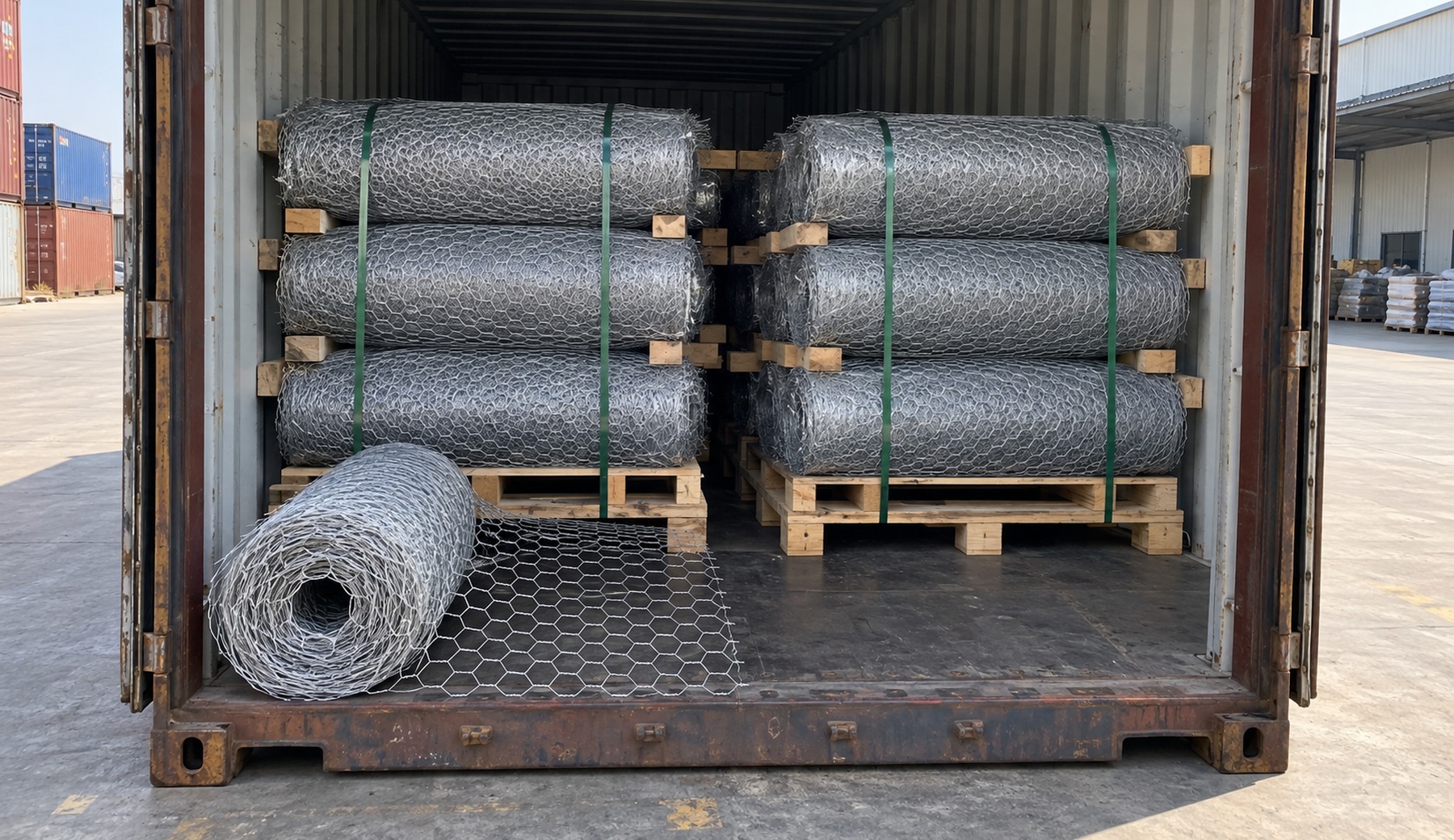
The source guide estimates approximately 18–22 tons for many 20-foot container loads and roughly 25–28 tons for certain 40-foot container configurations. Actual loading must be calculated for the exact product and container.
20-Foot Container Loading
A 20-foot container is commonly used for standard bulk wire mesh orders. Practical loading capacity can be lower than the container's rated payload because wire mesh rolls occupy substantial volume.
Indicative Loading by Wire Gauge
| Wire Gauge | Indicative Load | Possible Limiting Factor |
|---|---|---|
| 20–22 Gauge | Approx. 18–20 tons | Volume |
| 16–18 Gauge | Approx. 20–22 tons | Volume / Weight |
| 14–16 Gauge | Approx. 22–24 tons | Weight |
| 12–14 Gauge | Approx. 20–22 tons | Weight and packaging configuration |
40-Foot Container Considerations
A 40-foot container provides additional volume and can be useful for large shipments or products with larger roll dimensions.
However, a larger container does not automatically mean double the allowable cargo weight. Payload limits, road restrictions, port rules, and local transport regulations must also be checked.
Important: Ask the supplier for an estimated container loading plan based on the exact wire diameter, mesh opening, roll size, packaging, net weight, and gross weight.
What Packaging Is Best for Bulk Wire Mesh Shipping?
Good packaging protects the mesh during factory handling, container loading, ocean transport, unloading, and warehouse storage.
Plastic Film Wrapping
Protective wrapping can reduce exposure to moisture, dirt, and abrasion during transportation.
Wooden Pallets
Pallets can improve forklift handling and warehouse organization. When wood packaging is used for international shipments, applicable phytosanitary requirements should be confirmed.
Steel Banding
Heavy rolls may require banding to prevent movement and deformation. Banding pressure should be controlled so the packaging itself does not damage the mesh.
Packaging Checklist
- Roll protection
- Moisture resistance
- Strong strapping
- Stable stacking
- Clear product labels
- Shipping marks
- Net and gross weight labels where required
- Container loading compatibility
How Long Does Shipping from China Take?
Ocean freight transit time depends on origin port, destination port, vessel routing, transshipment, shipping line schedules, weather, port congestion, and customs clearance.
The source guide gives broad reference ranges of approximately 15–25 days for some African routes and 25–35 days for some South American routes. These should be treated as indicative transit times rather than guaranteed delivery schedules.

Indicative Africa Transit Times
| Region | Example Ports | Indicative Transit |
|---|---|---|
| West Africa | Lagos, Tema, Abidjan | Approx. 18–22 days |
| East Africa | Mombasa, Dar es Salaam | Approx. 20–25 days |
| South Africa | Durban, Cape Town | Approx. 22–28 days |
South America
Shipping times vary widely according to whether cargo travels to Pacific or Atlantic coast ports and whether transshipment is required.
Ports such as Callao or Valparaiso may have different routing structures from Santos, Buenos Aires, or Montevideo, so freight schedules should be confirmed for every shipment.
What Can Delay a Shipment?
- Port congestion
- Weather conditions
- Vessel schedule changes
- Transshipment delays
- Peak shipping season
- Chinese public holidays
- Incomplete export documentation
- Customs inspection
- Incorrect product classification
What Should You Check Before Importing from a China Supplier?
Supplier verification is particularly important for large bulk orders. Buyers should confirm both manufacturing capabilities and export experience.
Verify the supplier's legal identity, manufacturing capability, product quality system, sample quality, documentation, and shipping experience before committing to a large order.

Supplier Verification Checklist
| Verification Item | What to Request | What to Check |
|---|---|---|
| Business Identity | Current business license | Legal company name and registration details |
| Factory Capability | Factory photos, videos, audit | Production equipment and actual operations |
| Quality System | Certificates and inspection procedures | Validity and issuing organization |
| Product Quality | Samples and technical data | Wire diameter, opening, coating, dimensions |
| Export Experience | Shipping records or market references | Ability to prepare export documents and load containers |
Why Should You Request Samples Before a Bulk Order?
Samples allow buyers to verify product specifications before committing to full production.
- Measure actual wire diameter
- Check mesh opening
- Inspect twist consistency
- Evaluate galvanizing quality
- Check flexibility
- Compare samples from multiple suppliers
Quality Tip: A supplier's standard sample may not represent your exact specification. For large orders, request a sample matching the planned wire diameter, opening size, coating, and material whenever practical.
What Quality Documents Should You Request?
Documentation requirements depend on the project and destination market. Buyers may request:
- Material certificate
- Wire diameter inspection report
- Mesh opening inspection
- Zinc coating test report
- Tensile strength information
- Packing list
- Commercial invoice
- Certificate of origin where required
- Third-party inspection report where specified
How Do You Plan a Bulk Wire Mesh Import?
- Confirm Product Specification
Define wire diameter, mesh opening, roll width, roll length, coating, quantity, and packaging. - Verify the Supplier
Confirm legal identity, factory capability, quality systems, export experience, and production capacity. - Approve Samples
Verify key dimensions and finish before mass production where needed. - Compare FOB Pricing
Ensure suppliers are quoting the same technical specification. - Calculate FCL vs LCL
Obtain freight quotations and compare total logistics costs. - Check Container Loading
Confirm estimated rolls, net weight, gross weight, and container utilization. - Confirm Import Requirements
Verify HS classification, duties, certificates, and customs documentation. - Monitor Production
Confirm inspection results before shipment. - Review Shipping Documents
Check invoice, packing list, bill of lading details, and other required documents.
What Information Should You Send for a Shipping Quote?
Bulk Hexagonal Wire Mesh RFQ Checklist
- Wire diameter
- Hexagonal mesh opening
- Roll width and length
- Galvanized or coated finish
- Zinc coating requirement
- Total quantity
- Estimated order weight
- Packaging requirements
- Preferred Incoterm
- Destination port
- Required delivery schedule
- Quality documentation requirements
Conclusion
Importing bulk hexagonal wire mesh from China requires coordination between product sourcing, quality control, packaging, container loading, ocean freight, customs, and local delivery.
LCL can provide flexibility for smaller orders, while FCL becomes increasingly attractive as shipment volume approaches a practical container load. The best choice should be based on complete landed cost rather than freight price or shipment weight alone.
For professional B2B purchasing, buyers should confirm technical specifications, request appropriate quality documentation, verify supplier capabilities, and obtain a loading plan before finalizing a large shipment.