


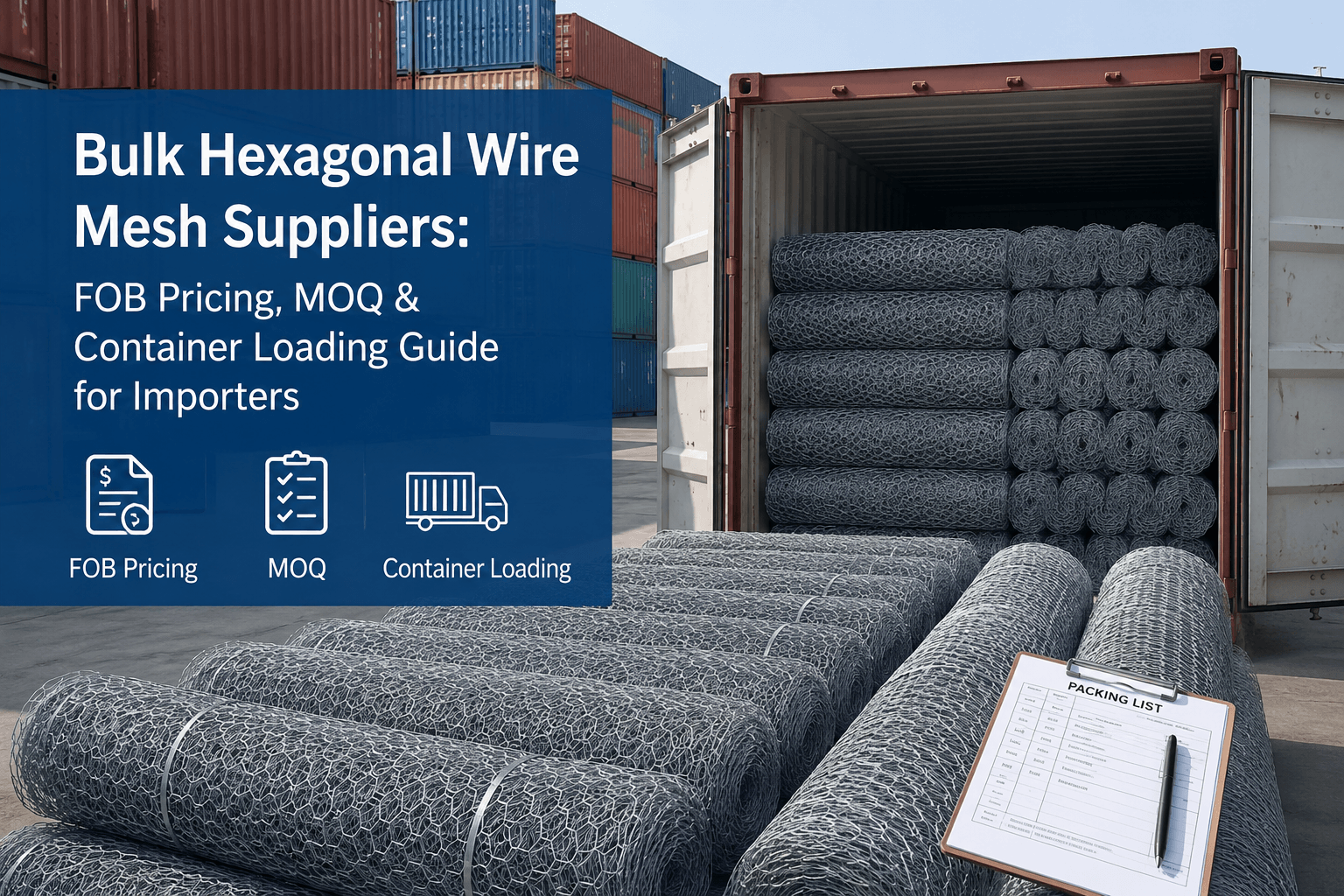
Bulk Hexagonal Wire Mesh Suppliers: FOB Pricing, MOQ & Container Loading Guide for Importers?
Last month, I received a call from a distributor in Kenya who needed 25 tons of hexagonal wire mesh. He was frustrated because three suppliers gave him completely different prices and container loading calculations.
This comprehensive guide covers FOB pricing, minimum order quantities, container loading calculations, and supplier selection criteria for bulk hexagonal wire mesh imports. You’ll learn exact pricing formulas, shipping methods, and how to avoid common importing mistakes.

After 15 years in the wire mesh export business, I’ve helped over 2,000 importers navigate these exact challenges. The key is understanding the real factors that affect your landed costs.
What Is the FOB Price of Hexagonal Wire Mesh?
Many importers ask for prices without providing complete specifications. This creates confusion and delays in getting accurate quotes.
FOB prices for hexagonal wire mesh range from $580-$1,200 per ton depending on wire diameter, mesh opening, surface treatment, and packaging method. Standard galvanized 1” mesh typically costs $650-$750 per ton FOB China.

The FOB price structure includes several components that directly impact your final cost. Wire diameter affects material usage - thicker wires cost more but provide better strength. Mesh opening size influences manufacturing complexity. Smaller openings require more precise machinery settings.
Surface treatment creates the biggest price variation. Hot-dip galvanized costs $80-120 more per ton than electro-galvanized. PVC coating adds $150-200 per ton. Stainless steel versions cost 3-4 times more than carbon steel.
| Wire Diameter | Mesh Opening | Galvanized FOB | PVC Coated FOB | Weight per m² |
|---|---|---|---|---|
| 0.9mm | 13mm (1/2”) | $720-780 | $880-950 | 0.85kg |
| 1.2mm | 25mm (1”) | $650-720 | $800-870 | 0.95kg |
| 1.6mm | 50mm (2”) | $680-750 | $830-900 | 1.15kg |
Packaging method also affects FOB pricing. Standard plastic wrapping costs nothing extra. Wooden pallets add $15-25 per ton. Individual carton packaging for retail adds $80-120 per ton.
What Is Hexagonal Wire Mesh Used For?
Understanding applications helps you specify the right product and avoid over-engineering costs. Different uses require different specifications.
Hexagonal wire mesh serves primarily in poultry farming, garden fencing, gabion construction, and industrial filtration. Each application requires specific wire diameter, mesh size, and surface treatment for optimal performance and cost-effectiveness.

Poultry farming represents 60% of our hexagonal mesh sales. Chicken coops need 13mm or 19mm openings to prevent predator entry while allowing ventilation. Wire diameter of 0.9-1.2mm provides adequate strength. Galvanized coating offers 8-12 years of rust resistance in normal conditions.
Garden fencing applications prefer larger 25mm openings for plant support and small animal exclusion. The 1.2mm wire diameter balances cost and durability. PVC coating in green color helps the mesh blend with vegetation while providing 15-20 years of service life.
Gabion construction requires heavy-duty specifications. Wire diameter must be 2.0-3.0mm minimum. Mesh openings of 60-100mm allow proper stone placement. Heavy galvanizing (275g/m² zinc coating) ensures 50+ year lifespan in harsh environments.
Industrial applications like filtration or machine guards need custom specifications. Stainless steel material prevents contamination. Precise mesh openings control particle size. Food-grade certifications may be required for processing equipment.
What Is the HS Code for Hexagonal Wire Mesh?
Correct HS codes determine import duties and customs clearance procedures. Wrong codes cause delays and additional costs at destination ports.
Hexagonal wire mesh typically uses HS code 7314.20 for galvanized versions and 7314.41 for PVC coated mesh. However, specific classifications depend on wire diameter, coating type, and intended use in your destination country.

The primary HS code 7314.20 covers “grill, netting and fencing, welded at the intersection, of wire with a maximum cross-sectional dimension of 3mm or more, plated or coated with zinc.” This applies to most standard galvanized hexagonal mesh.
PVC coated versions often fall under 7314.41 or 7314.42 depending on coating thickness and base material. Some countries classify thick PVC coated mesh as plastic products under Chapter 39.
Wire diameter affects classification boundaries. Mesh with wire under 3mm diameter may use different codes in the 7314.10 series. Stainless steel versions typically use 7314.31 or 7314.39.
| Product Type | Primary HS Code | Alternative Codes | Typical Duty Rate |
|---|---|---|---|
| Galvanized Hex Mesh | 7314.20 | 7314.14, 7314.19 | 5-15% |
| PVC Coated Mesh | 7314.41 | 7314.42, 3926.90 | 8-20% |
| Stainless Steel | 7314.31 | 7314.39 | 10-25% |
Always verify the exact HS code with your customs broker before shipping. Import duties vary significantly between countries and trade agreements affect rates. COMESA member countries often have preferential rates for our Ethiopian factory products.
How Do You Calculate Wire Mesh Weight and Price?
Accurate weight calculations prevent container overloading and help verify supplier quotes. Many importers receive incorrect calculations that affect shipping costs.
Wire mesh weight equals wire length per square meter multiplied by wire weight per meter. For hexagonal mesh, calculate total wire length using the formula: (2 × mesh width ÷ opening size + 1) × wire diameter × 0.00617 kg/m for steel wire.

The basic calculation starts with understanding mesh geometry. Hexagonal mesh has both horizontal and diagonal wires. Each square meter contains approximately (1000mm ÷ opening size) horizontal wires and (866mm ÷ opening size) diagonal wires due to the 60-degree angle.
For 1” (25mm) opening mesh with 1.2mm wire diameter: - Horizontal wires: 1000mm ÷ 25mm = 40 wires per meter width - Diagonal wires: 866mm ÷ 25mm = 35 wires per meter width - Total wire length per m²: (40 + 35) × 1000mm = 75,000mm = 75 meters - Wire weight: 1.2mm diameter = 0.00888 kg/m - Total weight: 75m × 0.00888 kg/m = 0.666 kg/m²
This theoretical weight must be adjusted for manufacturing tolerances. Add 5-8% for wire overlaps at intersections. Galvanizing adds 3-5% weight. PVC coating adds 15-25% depending on thickness.
Price calculation multiplies weight by material cost plus processing fees. Current steel wire costs $0.65-0.75 per kg. Galvanizing adds $0.08-0.12 per kg. Manufacturing and overhead add $0.15-0.25 per kg.
How much does hexagonal wire mesh cost per ton?
Ton pricing varies significantly based on specifications and order quantities. Understanding price ranges helps evaluate supplier competitiveness.
Hexagonal wire mesh costs $580-$1,200 per ton FOB China. Standard galvanized 1” mesh ranges $650-$750 per ton. PVC coated versions cost $800-$950 per ton. Stainless steel grades cost $2,800-$3,500 per ton.

Price variations depend on multiple factors beyond basic specifications. Wire diameter significantly impacts material costs. Thicker wires use more raw material but reduce manufacturing complexity. The sweet spot for cost-effectiveness is 1.0-1.4mm diameter.
Mesh opening size affects manufacturing efficiency. Standard sizes like 13mm, 19mm, and 25mm have lower costs due to high-volume production. Custom sizes require machine adjustments and may add $20-50 per ton.
Surface treatment creates the largest price spread. Electro-galvanized coating is cheapest but offers limited corrosion resistance. Hot-dip galvanizing costs more but provides 3-4 times longer service life. PVC coating offers the best longevity but doubles the material cost.
| Wire Gauge | Opening Size | Electro-Galv | Hot-Dip Galv | PVC Coated | Stainless |
|---|---|---|---|---|---|
| 20 gauge (0.9mm) | 1/2” (13mm) | $580-630 | $720-780 | $880-950 | $2800-3200 |
| 18 gauge (1.2mm) | 1” (25mm) | $620-680 | $650-720 | $800-870 | $2900-3300 |
| 16 gauge (1.6mm) | 2” (50mm) | $680-740 | $680-750 | $830-900 | $3100-3500 |
Order quantity affects pricing through volume discounts. Orders under 5 tons may carry 10-15% price premiums. Orders over 50 tons typically receive 3-5% discounts. Container load quantities (20-25 tons) offer the best balance of price and logistics efficiency.
What is the MOQ for bulk chicken wire mesh?
Minimum order quantities balance manufacturing efficiency with customer needs. Understanding MOQ helps plan inventory and cash flow.
Our MOQ for hexagonal wire mesh is 2 tons per specification. This applies to standard sizes and surface treatments. Custom specifications require 5-ton minimums. Mixed container loads accept 1-ton minimums per item when total order exceeds 15 tons.

The 2-ton MOQ reflects manufacturing setup costs and efficiency requirements. Changing wire diameter or mesh size requires machine adjustments that take 2-4 hours. Small quantities don’t justify these setup costs, resulting in higher per-ton pricing.
Standard specifications include common combinations of wire diameter and opening size. These items maintain inventory levels that allow smaller MOQs. Custom specifications require dedicated production runs with higher minimums.
Mixed container loading offers flexibility for distributors needing multiple products. A 20GP container holds 20-22 tons depending on packaging. You can combine different mesh sizes, wire products, and nail products to reach container capacity while meeting individual MOQs.
Seasonal demand affects MOQ enforcement. During peak seasons (March-August), we may reduce MOQs to 1.5 tons for standard items. Off-season periods may require higher minimums due to reduced production scheduling.
Special packaging requirements increase MOQs. Standard plastic wrap packaging has no quantity restrictions. Wooden pallet packaging requires 5-ton minimums due to pallet costs and container space efficiency. Individual retail packaging needs 10-ton minimums to justify setup costs.
How many rolls fit in a 20GP or 40HQ container?
Container loading calculations determine shipping costs and inventory planning. Incorrect calculations cause weight overages or wasted space.
A 20GP container holds 18-22 tons or 800-1,200 rolls depending on roll dimensions and packaging. A 40HQ container holds 24-26 tons or 1,200-1,800 rolls. Weight limits typically restrict loading before volume limits.

Roll dimensions significantly affect container utilization. Standard rolls are 1.0-1.5m wide and 25-50m long. Larger rolls reduce handling costs but may not fit efficiently in container dimensions. The 20GP container interior measures 5.9m × 2.35m × 2.39m.
Weight distribution matters for safe transport. Wire mesh has high density compared to volume. A 20GP container reaches its 22-ton weight limit with only 60-70% volume utilization. Proper weight distribution prevents container tipping and reduces damage risk.
Packaging method affects loading efficiency. Plastic-wrapped rolls stack easily but may shift during transport. Wooden pallet packaging provides stability but reduces total quantity. Steel banding offers the best balance of protection and space efficiency.
| Container Type | Max Weight | Typical Rolls | Roll Size | Loading Method |
|---|---|---|---|---|
| 20GP | 22 tons | 800-1000 | 1×30m | Floor loaded |
| 20GP Palletized | 20 tons | 600-800 | 1×25m | Forklift loaded |
| 40HQ | 26 tons | 1200-1500 | 1×30m | Floor loaded |
| 40HQ Palletized | 24 tons | 900-1200 | 1×25m | Forklift loaded |
Loading time affects port costs. Floor-loaded containers require 4-6 hours for loading and securing. Palletized loading takes 2-3 hours but costs more for pallet materials. Consider destination port handling capabilities when choosing packaging methods.
What affects FOB China prices?
Understanding price factors helps negotiate better terms and predict cost changes. Multiple variables affect your final FOB price beyond basic specifications.
FOB China prices fluctuate based on raw material costs, energy prices, labor rates, exchange rates, and shipping capacity. Steel wire prices have the biggest impact, typically representing 60-70% of total production costs.

Raw material costs create the largest price variations. Steel wire rod prices fluctuate based on iron ore costs, coal prices, and steel mill capacity utilization. Prices can swing $50-100 per ton monthly during volatile periods. We typically hold quotes for 15-30 days to manage this risk.
Energy costs affect galvanizing and PVC coating processes. Natural gas prices impact furnace operations. Electricity costs affect wire drawing machinery. Government environmental policies can restrict production during high pollution periods, creating temporary supply shortages.
Labor costs increase 5-8% annually in China’s manufacturing regions. Skilled operators for wire mesh machinery command premium wages. Social insurance and safety compliance costs continue rising. These factors create steady upward pressure on manufacturing costs.
Exchange rate fluctuations between USD and RMB affect competitiveness. A stronger RMB increases FOB USD prices. We monitor rates daily and may adjust quotes for large orders with extended delivery periods. Currency hedging is available for orders over $100,000.
Transportation costs within China impact FOB pricing. Rising fuel costs increase trucking from factory to port. Port congestion creates delays and storage fees. We maintain warehouse space near major ports to reduce these risks for customers.
Is galvanized or PVC coated wire mesh cheaper?
Surface treatment selection balances initial cost against service life and maintenance requirements. The cheapest option isn’t always the most economical long-term choice.
Galvanized wire mesh costs 20-30% less than PVC coated versions initially. However, PVC coating lasts 2-3 times longer in outdoor applications, making it more cost-effective over 10+ year periods despite higher upfront costs.

Initial cost differences reflect material and processing requirements. Galvanizing involves zinc coating application through hot-dip or electro-plating processes. PVC coating requires primer application, powder coating, and high-temperature curing. The additional processing steps increase manufacturing time and energy costs.
Service life comparisons depend heavily on environmental conditions. In mild climates with low humidity, galvanized mesh may last 8-12 years. Coastal or industrial environments with salt exposure reduce this to 3-5 years. PVC coating maintains protection for 15-25 years in most conditions.
Maintenance costs favor PVC coating for permanent installations. Galvanized mesh requires periodic inspection and touch-up painting in corrosive environments. PVC coating needs only occasional cleaning to maintain appearance and performance. Labor costs for maintenance often exceed material savings from cheaper galvanized options.
| Environment | Galvanized Life | PVC Life | 10-Year Cost Comparison |
|---|---|---|---|
| Indoor/Dry | 15+ years | 25+ years | Galvanized 20% cheaper |
| Moderate Outdoor | 8-12 years | 20-25 years | Similar costs |
| Coastal/Industrial | 3-5 years | 15-20 years | PVC 30% cheaper |
Application requirements may dictate surface treatment choice regardless of cost. Food processing facilities need stainless steel or food-grade PVC. Decorative applications prefer color-matched PVC coating. Temporary installations may use the cheapest electro-galvanized option.
How long is production time?
Production scheduling affects project timelines and inventory planning. Understanding lead times helps coordinate with construction schedules and seasonal demand.
Standard hexagonal wire mesh production takes 15-25 days from order confirmation. Custom specifications require 25-35 days. Peak season periods (March-August) may extend lead times by 5-10 days due to higher demand.

Production time varies by order complexity and factory capacity utilization. Standard specifications using common wire diameters and mesh sizes process faster. Our inventory management maintains raw materials for popular combinations, reducing setup time.
Custom specifications require additional processing steps. Non-standard wire diameters need special drawing dies. Unusual mesh openings require machine calibration. Custom PVC colors need color matching and approval samples. These factors add 10-15 days to standard production schedules.
Order quantity affects production scheduling efficiency. Large orders receive dedicated production runs with faster per-ton processing. Small orders may wait for batch production with similar specifications. Container load quantities typically receive priority scheduling.
Quality control requirements extend production time but ensure compliance. Third-party inspections add 2-3 days for scheduling and testing. Special certifications require additional documentation and may need witness testing. We recommend building these requirements into project timelines.
Seasonal demand creates capacity constraints during peak periods. Spring and summer months see 40-60% higher demand for agricultural and construction applications. Early ordering and flexible delivery dates help secure better pricing and faster production during these periods.
What certifications should a supplier have?
Proper certifications ensure product quality, compliance, and smooth customs clearance. Missing certifications cause delays and additional costs at destination ports.
Essential certifications include ISO 9001 quality management, material test certificates, and destination-specific standards like CE marking for Europe or ASTM compliance for North America. Third-party inspection certificates provide additional quality assurance for large orders.

ISO 9001 certification demonstrates systematic quality management processes. This covers raw material procurement, production control, testing procedures, and customer service standards. We maintain annual audits to ensure continuous compliance and improvement.
Material certifications verify chemical composition and mechanical properties. Mill test certificates show steel wire compliance with international standards. Galvanizing certificates confirm zinc coating thickness and adhesion. These documents support customs clearance and end-user requirements.
Regional standards compliance varies by destination market. European markets require CE marking for construction products. North American customers need ASTM standard compliance. Australian markets require AS/NZS standards. We maintain testing and certification for major export markets.
Third-party inspection services provide independent quality verification. SGS, BV, and TUV offer pre-shipment inspection services. These reports document dimensions, coating thickness, tensile strength, and packaging quality. Insurance companies may require these certificates for large shipments.
Environmental certifications support sustainable sourcing requirements. Our factories maintain environmental management systems and pollution control certificates. Recycled content documentation supports green building requirements. Lead-free certifications ensure safety for consumer applications.
How do I choose a reliable wire mesh supplier in China?
Supplier selection determines long-term business success and risk management. The wrong choice leads to quality issues, delivery delays, and financial losses.
Evaluate suppliers based on manufacturing capacity, quality systems, export experience, financial stability, and communication capabilities. Factory visits or third-party audits provide the best assessment of actual capabilities versus marketing claims.

Manufacturing capacity assessment starts with production equipment evaluation. Modern wire mesh machinery produces consistent quality and higher efficiency. Automated galvanizing lines ensure uniform coating thickness. In-house testing equipment demonstrates quality commitment rather than reliance on external labs.
Export experience indicates understanding of international requirements. Suppliers with 5+ years of export history understand documentation requirements, packaging standards, and shipping procedures. Long-term customer relationships demonstrate reliability and service quality.
Financial stability protects against supply disruptions. Request business licenses, tax certificates, and bank references. Suppliers with multiple facilities or overseas operations show growth and stability. Avoid new companies or those with recent ownership changes during critical project periods.
Quality system documentation provides insight into process control. Request quality manuals, testing procedures, and calibration certificates. Suppliers with formal quality systems handle specifications changes and customer requirements more effectively.
Communication capabilities affect order management and problem resolution. Suppliers with English-speaking staff and international experience respond faster to inquiries. Time zone considerations matter for urgent communications. We maintain 24-hour response capabilities for customer service.
Reference checks with existing customers provide real performance data. Request contact information for customers in similar markets or applications. Ask about quality consistency, delivery performance, and problem resolution capabilities. Long-term relationships indicate supplier reliability.
Conclusion
Successful hexagonal wire mesh importing requires understanding FOB pricing structures, container loading calculations, and supplier evaluation criteria. These fundamentals protect your investment and ensure reliable supply chains.


