


The Role of Concrete Nails in Modern Construction
Modern construction projects require faster installation, stronger structural stability, and long-term durability. Traditional fastening methods are no longer enough for today’s building standards. That is why concrete nails have become one of the most important fastening components in modern construction systems.

Why Modern Buildings Require Stronger Fastening Systems
The modern construction industry is changing rapidly. Builders today face tighter project deadlines, higher labor costs, and stricter safety standards than ever before. According to PwC, the global construction industry is expected to exceed USD 15 trillion by 2030.
Modern buildings use more prefabricated materials, lightweight steel systems, modular structures, and energy-efficient designs. These systems require fastening products that can deliver both speed and structural reliability.
Traditional nails may bend, loosen, or fail when used on concrete or masonry surfaces. As a result, hardened steel concrete nails have become a preferred solution for contractors worldwide.
Why Concrete Nails Have Become Essential Construction Fasteners
Concrete nails are not ordinary nails. They are specially manufactured for high-strength applications involving concrete, brick, and masonry materials.
Unlike common wire nails, concrete nails are usually made from high-carbon steel and undergo heat-treatment processes to improve hardness and impact resistance.

| Feature | Benefit |
|---|---|
| High Hardness | Penetrates concrete surfaces effectively |
| Heat-Treated Steel | Improves bending resistance |
| Strong Holding Power | Enhances structural stability |
| Corrosion Resistance | Supports longer service life |
| Fast Installation | Improves construction efficiency |
What Are Concrete Nails Used For?
Concrete nails are used in a wide range of construction and installation projects. They are designed for fixing various materials directly onto concrete or masonry surfaces.
- Wood-to-concrete fastening
- Metal track installation
- Ceiling systems
- Interior decoration
- Electrical conduit fixing
- HVAC system installation
- Flooring support structures
- Temporary construction fixing

| Application | Recommended Nail Type |
|---|---|
| Wood to Concrete | Concrete Nails |
| Metal Track Systems | Concrete Pin Nails |
| Ceiling Installation | Galvanized Concrete Nails |
| Industrial Construction | Hardened Steel Concrete Nails |
| Decorative Installation | Small Head Concrete Nails |
Concrete Nails How to Use in Different Construction Projects
Understanding concrete nails how to use properly is important for both installation safety and fastening performance. Incorrect installation may cause nail bending, cracking, or reduced holding strength.
- Choose the correct nail size: Match the nail length and diameter with the material thickness and concrete hardness.
- Mark the installation area: Identify fastening positions before installation.
- Use proper tools: Heavy-duty hammers or powder-actuated tools are commonly used.
- Install vertically: Drive the nail straight into the surface to reduce bending risk.
- Check fastening stability: Inspect the fixing point after installation.
Applications of Concrete Pin Nails in Modern Buildings
Concrete pin nails are becoming increasingly important in commercial and industrial construction projects. They provide faster installation and better compatibility with modern lightweight structures.

They are widely used in office buildings, shopping centers, warehouses, prefabricated structures, drywall systems, suspended ceilings, and mechanical or electrical installation.
Why Construction Companies Focus More on Concrete Nail Quality
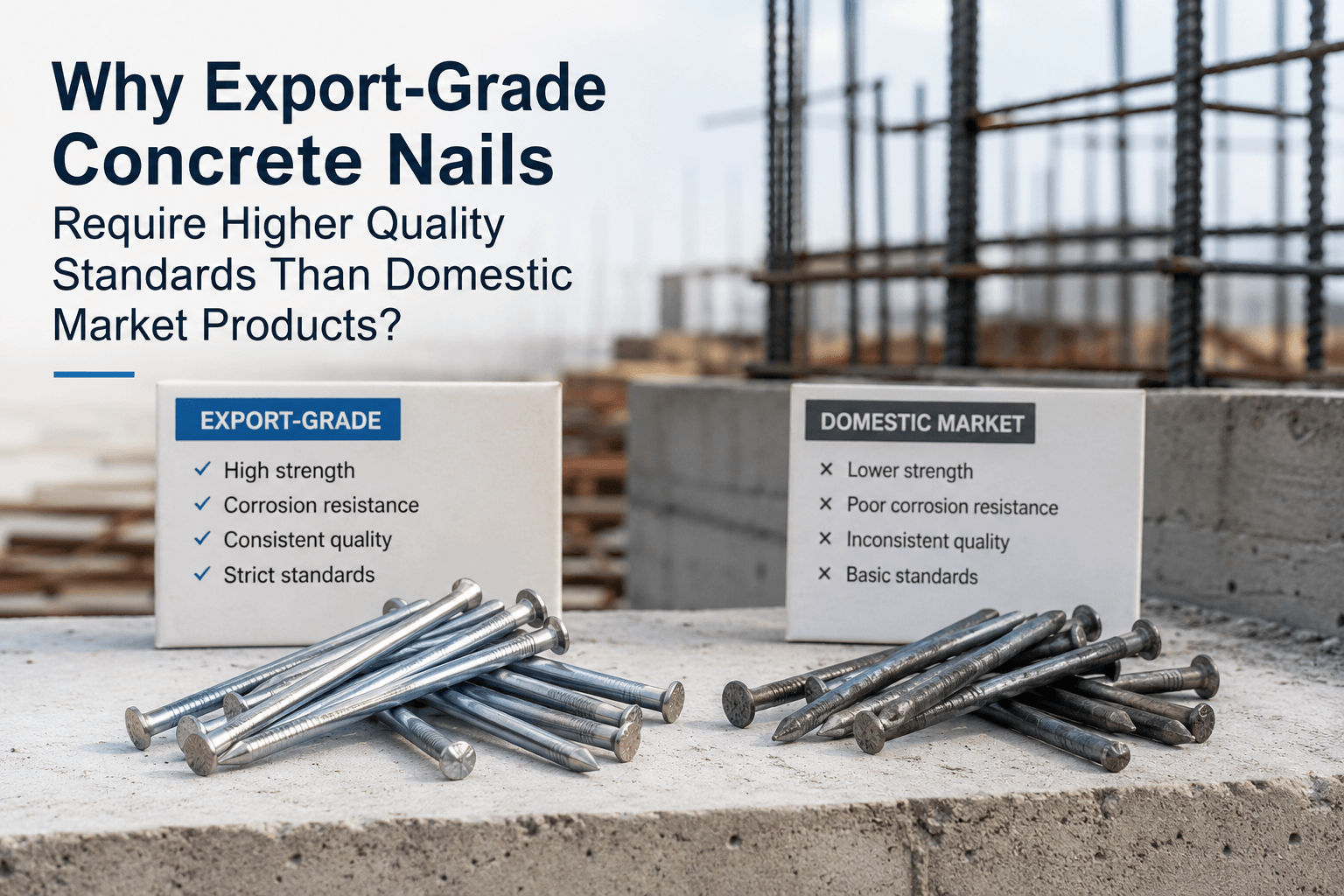
Construction companies today pay much closer attention to concrete nail quality than before. Poor-quality fastening products can lead to structural instability, installation failure, corrosion problems, higher maintenance costs, construction delays, and expensive project rework.
Buyers now focus more on material stability, heat-treatment consistency, corrosion resistance, dimensional accuracy, and reliable packaging standards.
Why Buyers Care About Concrete Nail Stability and Supply Consistency
Global buyers are not only purchasing products. They are also purchasing supply chain reliability. For construction projects, delayed shipments or inconsistent product quality can directly impact project schedules and labor planning.
Buyers increasingly focus on stable production capacity, reliable delivery timelines, international shipping support, OEM packaging services, flexible order quantities, and long-term supplier cooperation.
How to Choose a Reliable Concrete Nails Supplier
Choosing the right supplier is critical for long-term project success. A professional concrete nail manufacturer should provide stable manufacturing capacity, strict quality control, OEM and ODM customization, international export experience, and sample testing support.

About Dingzhou Best Hardware
Dingzhou Best Hardware is a professional construction nail manufacturer specializing in high-quality fastening products for global construction markets.
Main products include Concrete Nails, Black Steel Nails, Roofing Nails, Coil Nails, and Lost Head Nails.
The company supports OEM and ODM customization, including product specifications, packaging customization, and private logo branding.
| MOQ | 2 Tons or 80 Cartons |
|---|---|
| Pricing Method | FOB |
| Delivery Time | 15–25 Days |
| Shipping | FCL & LCL Sea Freight |
| Sample Policy | Samples Available for Testing |
| Customization | OEM / ODM / Packaging / Logo |
Future Trends of Concrete Fastening Systems
The future of the construction industry will continue driving demand for advanced fastening systems. Modular construction, smart buildings, green building standards, high-speed installation systems, and corrosion-resistant materials are all shaping the future of concrete nails.
As global construction projects become more industrialized, reliable concrete fastening solutions will remain essential.
FAQ
Are concrete nails stronger than regular nails?
Yes. Concrete nails are usually made from hardened high-carbon steel and heat-treated for better strength and impact resistance.
Can concrete nails be reused?
Usually no. Concrete nails are designed for single-use fastening because removal may reduce holding strength.
What size concrete nails should I use?
The correct size depends on the material thickness and concrete hardness. Longer nails generally provide stronger holding power.
Are galvanized concrete nails better for outdoor use?
Yes. Galvanized concrete nails offer better corrosion resistance in outdoor or humid environments.
Get Professional Concrete Nail Solutions
Looking for reliable concrete nails for sale, concrete pin nails, or OEM construction fasteners? Contact Dingzhou Best Hardware for specifications, engineering application solutions, OEM packaging, and wholesale FOB pricing.


