


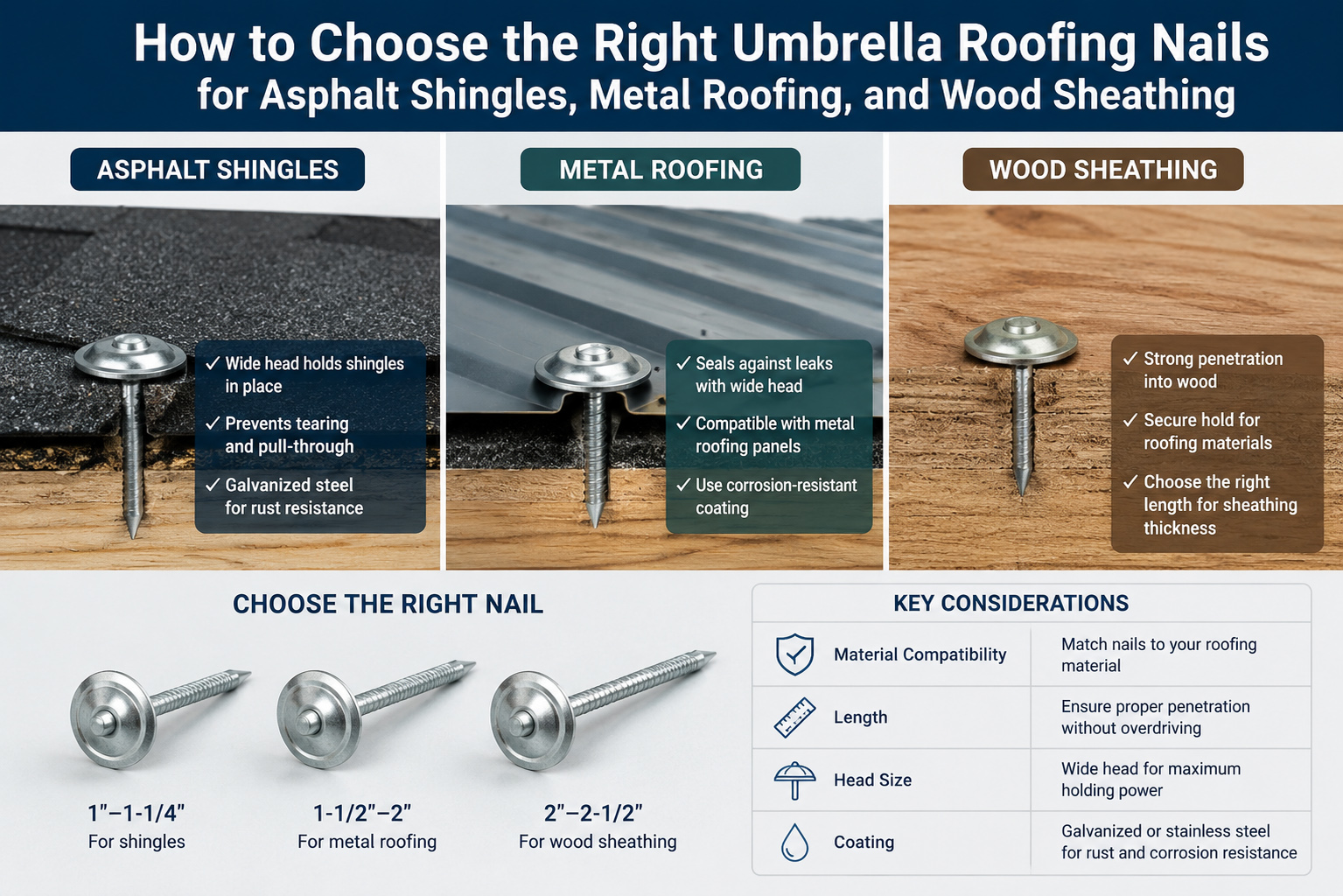
How to Choose the Right Umbrella Roofing Nails for Asphalt Shingles, Metal Roofing, and Wood Sheathing
Choosing roofing nails is not a small detail in a roofing project. For contractors, importers and distributors, the wrong nail can lead to leakage, nail pull-out, corrosion complaints and expensive after-sales claims. This guide explains how to match umbrella roofing nails with different roofing materials based on real application conditions.
As a roofing nails manufacturer and umbrella roofing nail factory, Best Hardware recommends buyers evaluate roofing nails as part of the whole roofing fastening system, not as a single low-cost consumable.

Umbrella roofing nails should be selected according to roofing material, coating requirement, shank type and substrate thickness.
Why Roofing Material Determines Roofing Nail Selection
Different roofing materials fail in different ways. Asphalt shingles are usually damaged by wind uplift and incorrect nail placement. Metal roofing panels are more sensitive to thermal expansion, hole enlargement and corrosion. Wood sheathing and OSB boards lose holding strength when moisture changes cause swelling and shrinkage.
That is why a roofing nail should be selected by four factors:
| Selection Factor | Why It Matters | What Buyers Should Check |
|---|---|---|
| Nail Length | Controls penetration depth and holding strength. | Roofing material thickness, underlayment and deck thickness. |
| Shank Type | Affects pull-out resistance. | Ring shank for stronger grip; smooth shank for light-duty or cost-sensitive use. |
| Surface Coating | Determines corrosion resistance. | Electro galvanized for general use; hot dipped galvanized for humid or coastal areas. |
| Head Design | Controls bearing area and waterproofing performance. | Umbrella head diameter, washer compatibility and head consistency. |
What Are Umbrella Roofing Nails?
Umbrella roofing nails are roofing fasteners with a wide umbrella-shaped head. The larger head helps distribute pressure across roofing materials and reduces the risk of tearing, especially when fastening thin sheets, asphalt materials or waterproof layers.
Common materials include Q195 and Q235 steel wire. Common finishes include electro galvanized, hot dipped galvanized, zinc coated and painted coating. For export markets, galvanized roofing nails are widely used because they offer a better balance between cost, corrosion resistance and installation performance.

Production consistency, coating quality and head forming accuracy are key factors for bulk roofing nail orders.
Roofing Nail Structure and Key Dimensions Buyers Should Know
For B2B buyers, roofing nail quality should not be judged only by appearance. A professional buyer should check the head diameter, shank diameter, nail length, point sharpness and coating thickness.
| Part | Function | Common Quality Problem | Procurement Suggestion |
|---|---|---|---|
| Umbrella Head | Increases bearing surface and improves material holding. | Uneven head size may cause unstable fastening pressure. | Request head diameter tolerance confirmation before bulk order. |
| Shank | Provides holding strength inside the roof deck. | Thin shank may reduce pull-out resistance. | Choose ring shank for higher grip applications. |
| Point | Helps the nail penetrate roofing material smoothly. | Blunt points slow installation and damage material. | Check samples before mass production. |
| Coating | Protects steel from rust and corrosion. | Thin zinc coating may corrode early in humid markets. | Use hot dipped galvanized nails for coastal or rainy regions. |
Best Umbrella Roofing Nails for Asphalt Shingles
Asphalt shingles are lightweight, layered and vulnerable to wind uplift. In this application, the nail must pass through the shingle and underlayment, then penetrate the roof deck deeply enough to hold the system securely.
For most asphalt shingle applications, galvanized ring shank roofing nails are preferred because the ring shank improves holding strength. In high-wind zones, using smooth shank nails only to reduce cost may increase the risk of nail loosening.
| Application Scenario | Recommended Nail | Recommended Finish | Why This Works |
|---|---|---|---|
| Standard residential asphalt shingles | 1"–1.25" umbrella roofing nails | Electro galvanized or hot dipped galvanized | Provides enough holding power for common roofing systems. |
| High-wind areas | 1.25"–1.5" ring shank roofing nails | Hot dipped galvanized | Improves pull-out resistance and reduces wind uplift failure. |
| Thick laminated shingles | 1.5" roofing nails | Hot dipped galvanized | Ensures deeper penetration through thicker roofing layers. |
| Humid or rainy markets | Galvanized umbrella roofing nails | Hot dipped galvanized preferred | Better corrosion resistance around fastening points. |
Best Umbrella Roofing Nails for Metal Roofing Panels
Metal roofing panels expand and contract when temperature changes. This movement repeatedly stresses the fastening points. If the nail is not corrosion-resistant or does not seal properly, the roof may develop enlarged holes, rust marks and leakage around the nail head.
For corrugated metal sheets, galvanized umbrella roofing nails with sealing washers are commonly used. In coastal or industrial environments, hot dipped galvanized roofing nails are a safer option because salt, humidity and chemical exposure accelerate corrosion.

Metal roofing panels require roofing nails with corrosion resistance and stable sealing around the fastening point.
| Metal Roofing Scenario | Risk | Recommended Nail Solution |
|---|---|---|
| Corrugated galvanized sheet roofing | Water entering around nail holes. | Umbrella roofing nails with sealing washer. |
| Coastal roofing project | Fast corrosion from salt and humidity. | Hot dipped galvanized roofing nails. |
| Industrial warehouse roofing | Chemical exposure and condensation. | Higher zinc coating and stronger packaging protection. |
| Large-span metal roofing | Thermal movement and hole enlargement. | Correct nail length, washer selection and controlled installation pressure. |
Choosing Roofing Nails for Wood Sheathing and OSB Boards
Wood sheathing and OSB boards are not static materials. They absorb moisture, expand, dry and shrink. This movement can reduce nail grip over time, especially when nails are too short, too smooth or too thin.
For plywood or OSB roof decks, the main goal is not only to fasten the roofing material, but also to maintain long-term holding power inside the wood substrate. This is why nail length and shank type become especially important.
| Substrate Type | Common Problem | Recommended Nail Selection | Reason |
|---|---|---|---|
| 7/16" OSB board | Nail backing out after moisture cycling. | Ring shank umbrella roofing nails. | Ring shank improves grip inside engineered wood fibers. |
| Plywood roof deck | Layer movement and reduced holding strength. | Galvanized roofing nails with proper penetration depth. | Maintains stable fastening across layered wood structure. |
| Old wood sheathing repair | Weak deck condition and uneven density. | Longer nails with stronger shank diameter. | Improves anchoring in aged or softer wood. |
| Humid climate roofing | Rust and wood movement at the same time. | Hot dipped galvanized ring shank nails. | Combines corrosion resistance with higher pull-out strength. |
Common Roofing Nail Selection Mistakes and How to Fix Them
Many roofing nail problems happen because buyers separate price from application conditions. A low-cost nail may work in a dry, low-wind market, but fail quickly in coastal, humid or high-wind regions.
| Mistake | Why It Happens | Consequence | Correct Solution |
|---|---|---|---|
| Using nails that are too short | Buyer only checks unit price, not roof build-up thickness. | Poor penetration and weak holding power. | Confirm roofing layer thickness and deck thickness before ordering. |
| Using electro galvanized nails in coastal areas | Importers try to lower cost for price-sensitive markets. | Early rust, leakage risk and customer complaints. | Use hot dipped galvanized roofing nails for coastal or humid projects. |
| Using smooth shank nails for high-wind roofs | Shank type is ignored during quotation. | Nails may loosen under wind uplift. | Choose ring shank roofing nails for stronger pull-out resistance. |
| Ignoring packaging quality | Focus stays only on nail price. | Carton damage, moisture exposure and rust during shipping. | Use export-grade cartons, moisture protection and palletized loading. |
| No sample testing before bulk order | Buyer trusts photos only. | Dimension mismatch after shipment. | Request samples to check length, head size, shank and coating. |
How Bulk Buyers Should Choose a Roofing Nails Manufacturer
For importers, wholesalers and contractors, a reliable roofing nails manufacturer should provide more than production capacity. The supplier should understand different roofing systems, coating requirements, packaging needs and export logistics.
Before placing a bulk order, buyers should confirm the following details:
| Buyer Question | Why It Matters |
|---|---|
| Can the factory provide electro galvanized and hot dipped galvanized options? | Different markets require different corrosion resistance levels. |
| Can the nail length, head diameter and shank type be customized? | Different roofing materials need different fastening solutions. |
| Does the supplier support OEM packaging? | Important for distributors, retailers and local brand owners. |
| Can samples be provided before bulk production? | Helps buyers verify quality before container orders. |
| Can the supplier handle FCL and LCL shipping? | Important for trial orders and mixed product shipments. |
Why Manufacturing Quality Matters in Roofing Fastener Systems
Roofing nails are small products, but manufacturing inconsistency can create large project risks. Uneven nail heads may reduce sealing performance. Thin shanks may reduce pull-out strength. Poor galvanizing may cause rust before the roof reaches its expected service life.
A professional umbrella roofing nail factory should control:
- Steel wire quality
- Nail length tolerance
- Head diameter consistency
- Shank straightness
- Point sharpness
- Zinc coating quality
- Carton and pallet packaging strength

Quality inspection helps reduce dimensional inconsistency, coating problems and packaging damage before shipment.
Future Trends in Roofing Fastener Systems
Roofing fastener systems are moving toward higher corrosion resistance, better installation efficiency and longer service life. Contractors no longer evaluate fasteners only by purchase cost. They also consider leakage risk, maintenance cost, installation speed and warranty claims.
For roofing nail suppliers, this means future competition will depend more on material consistency, coating technology, customization ability and engineering support.
FAQ
What are umbrella roofing nails used for?
Umbrella roofing nails are used to fasten asphalt shingles, roofing felt, waterproof membranes, corrugated sheets and metal roofing panels.
Which roofing nails are best for asphalt shingles?
Galvanized ring shank roofing nails are commonly recommended because they provide better holding strength and wind uplift resistance.
Can umbrella roofing nails be used for metal roofing?
Yes. For metal roofing, buyers should choose corrosion-resistant umbrella roofing nails, preferably with sealing washers for better waterproofing.
Are hot dipped galvanized roofing nails better than electro galvanized nails?
Hot dipped galvanized roofing nails usually offer thicker zinc protection and better corrosion resistance, especially in humid, rainy or coastal areas.
What roofing nails should be used for OSB board?
For OSB board, ring shank roofing nails are preferred because they provide stronger grip and reduce the risk of nail backing out after moisture cycling.
How do I choose a reliable umbrella roofing nail factory?
Check production capacity, coating options, nail size tolerance, OEM/ODM support, sample policy, delivery time and export packaging experience.
About Best Hardware
Best Hardware, also known as Dingzhou Best Hardware, is a professional roofing nails manufacturer and umbrella roofing nail factory supplying roofing fastener products for global wholesale markets.
Main products include roofing nails, concrete nails, black steel nails, lost head nails and coil nails. The company supports OEM/ODM customization, including product specifications, packaging design and brand logo printing.
| MOQ | 2 tons or 80 cartons |
| Quotation Method | FOB price based on product type, specification, quantity and packaging method |
| Sample Policy | Samples are available for quality testing. Basic sample fee may be discussed for return in formal orders. |
| Customization | OEM/ODM support for product, packaging and brand logo |
| Delivery Time | 15–25 days, depending on order quantity |
| Shipping | Sea freight, FCL and LCL supported |
| Cooperation Mode | Trial orders supported |
Looking for a Reliable Umbrella Roofing Nail Factory?
Contact Best Hardware for roofing nail wholesale, OEM packaging, product customization and sample quality testing.
Website: //www.chinabesthw.com/
WhatsApp: +8618331061136
Email: info@chinabesthw.com


