


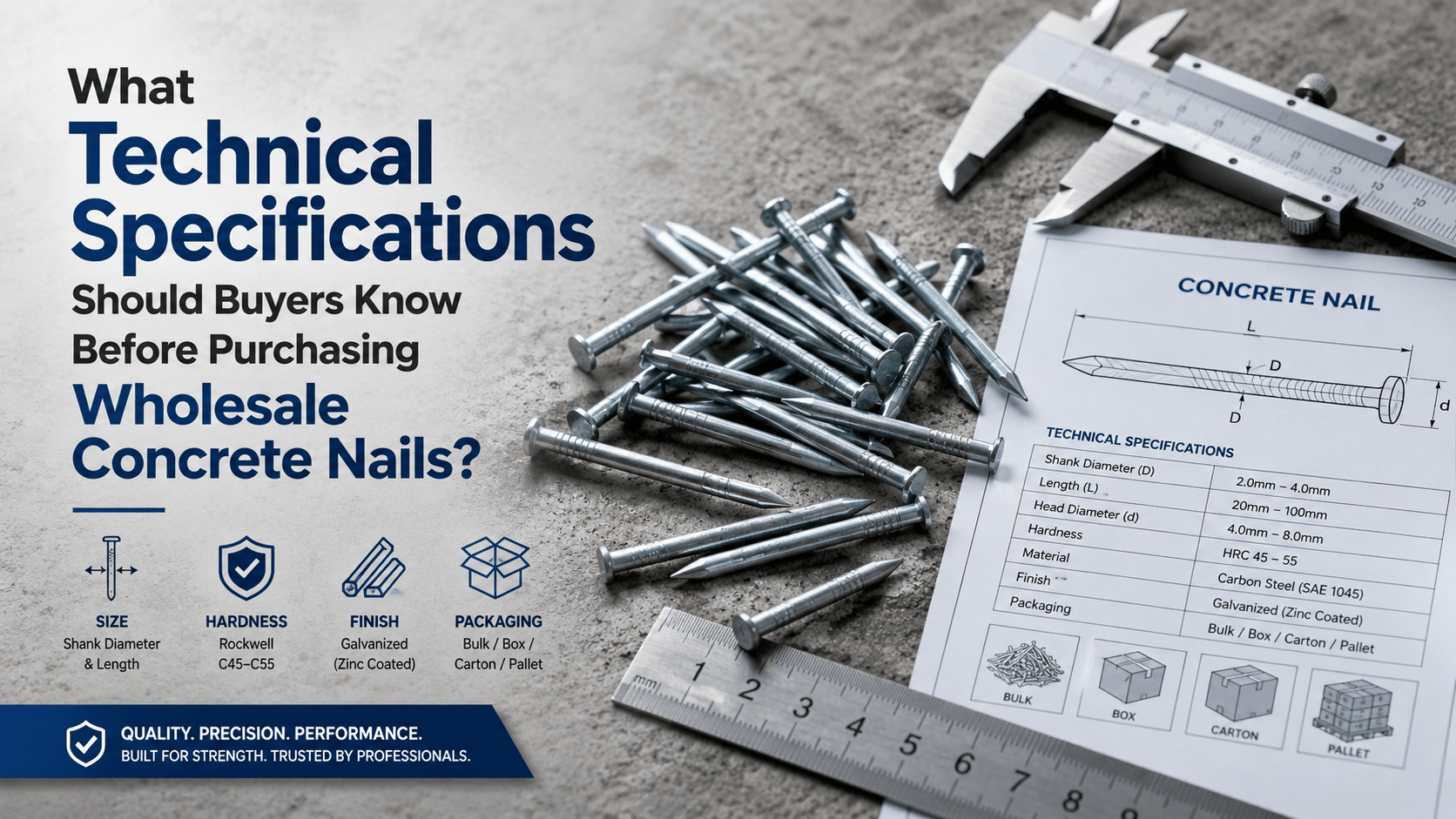
What Technical Specifications Should Buyers Know Before Purchasing Wholesale Concrete Nails?
Buying concrete nails in bulk is not only about getting a lower price. For hardware wholesalers, the wrong specification can cause bending, breakage, rust, customer complaints, and slow repeat orders. The right specs help you sell faster, reduce loss, and build a stronger nail business.
Wholesale buyers should check concrete nail specifications such as steel material, hardness range, heat treatment, length, diameter, shank type, head shape, point sharpness, surface finish, packaging, and application suitability. These details affect penetration strength, bending resistance, rust resistance, customer satisfaction, and resale efficiency.
This guide explains concrete nail specifications from a factory and wholesale purchasing angle, so buyers can match product performance with market demand.

Why Do Concrete Nail Technical Specifications Matter for Wholesale Buyers?
A concrete nail is a small product, but for wholesalers it can create repeat orders or customer complaints. Contractors expect the nail to enter hard material without bending. Retail shops want sizes that move quickly. Distributors need stable quality, strong cartons, and clear labels.
For hardware wholesalers in busy markets such as Dar es Salaam, specifications are not only factory details. They affect stock turnover, transport loss, customer trust, and brand reputation. Customers may compare price first, but they return when the product performs well on site.
This is why wholesale buyers should treat technical specifications as part of purchasing strategy. A low price is useful only when the nail has stable hardness, correct size, proper coating, and suitable packaging for local distribution.
What Factory Specifications Should Buyers Check Before Ordering Concrete Nails?
A concrete nail looks simple, but its performance is decided by several factory-controlled details. Buyers should check steel grade, wire drawing accuracy, heading quality, heat treatment, hardness range, shank design, surface finish, packing strength, and batch consistency.
In production, concrete nails are usually made from high-carbon steel wire. The wire is drawn to the required diameter, cut to length, headed, pointed, heat-treated, surface-finished, inspected, and packed. If one step is unstable, the nail may bend, crack, rust, or fail during installation.
| Specification | Common Factory Range | Why It Matters | Recommended Use |
|---|---|---|---|
| Material | High-carbon steel wire | Improves strength after heat treatment | Concrete, masonry, brick fixing |
| Hardness | Approx. HRC 45–55, depending on size and material | Controls bending and breakage performance | Medium and heavy-duty fastening |
| Length | 25 mm to 100 mm common range | Decides fixing depth | Retail, construction, repair work |
| Diameter | Approx. 2.5 mm to 5.0 mm | Affects holding power and driving resistance | Light fixing to heavy fixing |
| Shank Type | Smooth, fluted, grooved, twisted | Changes grip and pull-out resistance | Masonry, wood-to-concrete, general fixing |
| Surface Finish | Black, galvanized, blue, yellow | Affects rust resistance and market appearance | Indoor, outdoor, humid markets |
| Packing | Box, plastic bag, carton, OEM label | Affects resale, storage, and transport loss | Hardware wholesale and retail distribution |
Buyers can also compare related products through our wholesale common nails page or check our wholesale concrete nails product range for available sizes and packing options.
How Does Heat Treatment Affect Concrete Nail Performance?
Heat treatment is one of the most important steps in concrete nail production. Without proper heat treatment, high-carbon steel wire cannot reach the right balance between hardness and toughness.
A common reference process is quenching and tempering. Some factories use a quenching temperature of about 760–850°C, followed by oil quenching or controlled cooling. Tempering may be done at around 180–300°C, depending on wire material, nail diameter, and target hardness.
The exact setting should be controlled by the factory’s own process standard. For buyers, the key point is not only the highest hardness number. The real value is hardness consistency. If one batch has hard nails and soft nails mixed together, users will experience bending, cracking, and unstable driving performance.
Buyer tip: when checking samples, do not only inspect appearance. Ask for hardness range, test several pieces from the same batch, and compare performance after driving the nails into concrete or masonry blocks.
Which Concrete Nail Size Should Buyers Choose for Each Application?
Many buyers search for concrete nail specifications, but their real need is application matching. The best specification is not always the largest size. It depends on the customer’s job site, base material, installation habit, and price sensitivity.
| Application | Suggested Length | Suggested Diameter | Recommended Finish | Buyer Note |
|---|---|---|---|---|
| Light wall fixing | 25–38 mm | 2.5–3.2 mm | Black or galvanized | Good for small hardware shops and repair users |
| Wood-to-concrete fixing | 50–75 mm | 3.5–4.2 mm | Black or galvanized | Popular for general construction customers |
| Masonry and brick fixing | 50–100 mm | 3.8–5.0 mm | Galvanized preferred | Fluted or grooved shank can improve grip |
| Temporary formwork | 65–100 mm | 4.0–5.0 mm | Black finish | Buyers often care about cost and availability |
| Coastal or humid markets | Based on project need | Based on project need | Galvanized recommended | Better rust resistance during storage and use |
For mixed hardware wholesale, a balanced size range is usually safer than buying only one size. Contractors may buy bulk cartons, while small retailers may prefer branded boxes or smaller packs with clear labels.

What Quality Tests Should a Concrete Nail Factory Perform?
Before shipping bulk concrete nails, a factory should not only check appearance. For wholesale orders, quality control should include dimension inspection, hardness testing, bending checks, surface inspection, packing weight control, and carton strength inspection.
A practical inspection process may include checking nail length with a caliper, testing diameter tolerance, measuring hardness by Rockwell hardness tester, and doing a simple driving test on concrete or masonry blocks. For export cartons, gross weight and net weight should also be checked before loading.
| Test Item | What to Check | Why Buyers Should Care |
|---|---|---|
| Length Tolerance | Randomly measure samples from each batch | Prevents mixed-size complaints |
| Diameter Control | Check wire diameter after drawing | Ensures stable weight and holding power |
| Hardness Test | Use Rockwell hardness testing | Reduces bending and cracking risk |
| Bending Performance | Drive nails into concrete or test under side pressure | Shows real job-site performance |
| Surface Finish | Check coating coverage and rust spots | Important for humid storage and resale appearance |
| Packing Strength | Check carton thickness, sealing, and weight | Prevents breakage during container loading |
For large orders, buyers can request sample testing before shipment. You can also download concrete nail specification sheet to compare size, finish, packing, and loading details.
How Should Wholesale Buyers Compare Concrete Nail Prices per Kg?
Many buyers compare concrete nails by price per kg. This is normal in wholesale trade, but it is not enough. A lower price per kg may hide problems in wire diameter, hardness, surface treatment, packing quality, or nail count.
Buyers should compare how many nails are in one kg, whether the size is consistent, whether the nails bend during use, and whether the coating can handle local storage conditions. If the nails are soft, rusty, or packed in weak cartons, the final cost becomes higher than the purchase price.
Cheap nails may create more returns and customer complaints. Weak cartons may break during transport. Poor surface treatment may cause rust before the goods reach retail shelves. For wholesale business, stable quality is often more profitable than the lowest quotation.
What Packing Details Affect Wholesale Distribution?
Concrete nails are heavy products, so packaging must be treated as a technical specification. Weak cartons can break during loading, unloading, or warehouse storage. Poor labels can slow down stock management and confuse retail customers.
For hardware wholesalers, common packing options include small boxes, plastic bags, bulk cartons, woven bags, and customized OEM cartons. A strong package should show product size, weight, quantity, surface finish, brand, origin, and carton number clearly.
Private-label packaging is useful for buyers with their own brand. It improves shelf appearance and helps retailers sell with more confidence. Buyers can check our OEM packaging options for concrete nails, common nails, roofing nails, and mixed fastener orders.
Need Concrete Nail Specifications for Your Market?
Get size charts, packing details, OEM label options, and mixed-container suggestions for your wholesale hardware business.
How Can Buyers Choose a Reliable Concrete Nail Supplier?
A reliable supplier should provide clear technical specifications before production. Buyers should receive details about material, length, diameter, hardness range, shank type, head type, point type, surface finish, packing, carton size, and loading quantity.
Sample support is also important. Before placing a large order, buyers should test samples in real working conditions. A catalog photo cannot show whether the nail bends, cracks, or performs well in concrete.
Production stability matters when buyers want to build their own hardware brand. Every shipment should look and perform consistently. Customers should not feel that quality changes from one container to the next.
For buyers who work with Yiwu agents or China-based sourcing partners, communication is also important. The factory should provide product data, packing photos, loading information, export documents, and inspection support when needed.
Why Does Common Nail Factory Capability Matter for Mixed Orders?
Many hardware wholesalers do not buy only one product. They may sell concrete nails, common nails, roofing nails, wire nails, screws, mesh, tools, and other construction materials. So, it is useful to work with a supplier that understands multiple nail categories.
A strong common nail factory can often support standard nail production, packaging, size control, private-label cartons, and bulk loading. If the same supplier also understands concrete nails, buyers can manage more products from one source.
This is helpful for mixed orders. For example, a wholesaler may want concrete nails together with wholesale common nails in one container. This can improve purchasing efficiency, reduce communication costs, and make container planning easier.
When buyers search for terms such as common nails factory, they are often not looking for only one nail type. They usually want a stable nail manufacturer with wide production ability, flexible packing, and export experience.
Concrete Nail Specification FAQ for Wholesale Buyers
What hardness is suitable for concrete nails?
A common reference range for hardened steel concrete nails is around HRC 45–55. The exact hardness should depend on steel grade, nail diameter, heat treatment process, and application. Buyers should ask the factory for hardness consistency, not only a single test number.
What is the difference between smooth shank and fluted shank concrete nails?
Smooth shank concrete nails are suitable for general fixing and cost-sensitive orders. Fluted or grooved shank concrete nails offer better grip in masonry or harder base materials, but the unit cost may be higher.
Which concrete nail finish is better for Dar es Salaam or coastal markets?
For humid or coastal markets, galvanized concrete nails are usually better because they offer stronger rust resistance during storage and use. Black concrete nails are more cost-effective for fast-moving indoor or temporary construction use.
How should buyers check concrete nail packing before bulk orders?
Buyers should confirm inner packing, outer carton weight, carton thickness, label content, pallet option, and OEM design. Heavy nail cartons need strong sealing and clear marks to reduce warehouse and transport loss.
Can concrete nails and common nails be loaded in one container?
Yes. Many wholesalers order concrete nails together with common nails, roofing nails, or other fasteners. Working with a supplier that has both concrete nail and common nail factory capability can improve mixed-container efficiency.
What information should be included in a concrete nail specification sheet?
A complete specification sheet should include material, length, diameter, hardness range, shank type, head type, point type, surface finish, packing quantity, carton size, gross weight, net weight, and OEM packaging options.
Can buyers request private-label concrete nail packaging?
Yes. Many wholesale buyers request customized boxes, carton marks, logo labels, barcode labels, and mixed-size packing. OEM packaging helps local distributors build their own brand and improve shelf presentation.
Summary
Choosing wholesale concrete nails becomes easier when buyers understand the real meaning of technical specifications. Steel material, heat treatment, hardness consistency, size, shank type, finish, testing, and packaging all affect performance and resale value.
For hardware wholesalers, the best concrete nail is not simply the cheapest one. It is the product that matches local applications, reduces customer complaints, supports stable supply, and helps the buyer build repeat business in a competitive market.
Ready to Compare Concrete Nail Specifications?
Send your target size, packing style, market, and order quantity. We can help you choose suitable concrete nails, common nails, and mixed fastener options for wholesale distribution.


