


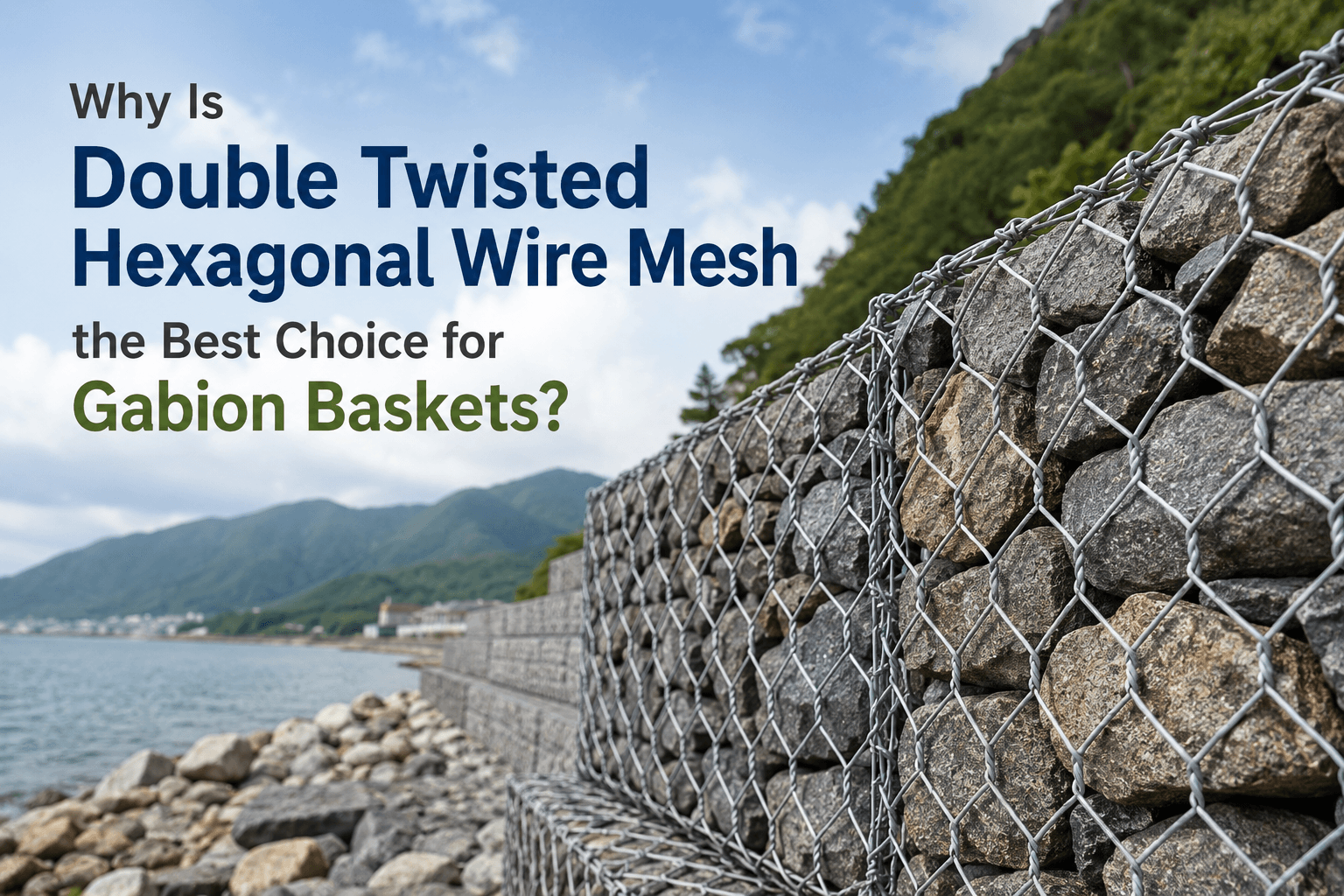
Why Is Double Twisted Hexagonal Wire Mesh the Best Choice for Gabion Baskets?
Building gabion baskets for your next project? You're facing a critical decision that could make or break your investment.
Double twisted hexagonal wire mesh stands as the superior choice for gabion baskets due to its self-locking structure, exceptional durability, and proven performance in erosion control applications. This mesh type prevents unraveling when damaged and maintains structural integrity for 50-75 years.

After manufacturing wire mesh for over two decades and supplying gabion materials to contractors across Africa, the Middle East, and South America, I've witnessed countless projects succeed and fail based on mesh selection. The difference between a 20-year gabion failure and a 75-year success story often comes down to one simple choice: the wire mesh type.
What Are the Negatives of Gabions? What Is the Life Expectancy of a Gabion?
Gabion projects seem perfect on paper. But real-world challenges can turn your investment into a costly mistake.
Gabion disadvantages include potential wire corrosion, bulging under pressure, and maintenance requirements. However, properly constructed gabions using galvanized double twisted hexagonal mesh typically last 50-75 years with minimal maintenance when installed correctly.

Let me share what I've learned from analyzing hundreds of gabion failures across different climates and applications. The most common problems stem from poor mesh selection and inadequate galvanization.
Common Gabion Problems and Solutions
| Problem | Cause | Solution |
|---|---|---|
| Wire corrosion | Poor galvanization | Use heavily galvanized mesh (275g/m²) |
| Mesh unraveling | Single twist construction | Choose double twisted hexagonal mesh |
| Bulging | Inadequate mesh strength | Select appropriate wire diameter (2.7-4.0mm) |
| Stone migration | Large mesh openings | Use 80x100mm or 60x80mm mesh size |
| Premature failure | Marine environment | Apply PVC coating over galvanization |
The life expectancy varies dramatically based on your environment. In my experience supplying gabion materials to coastal projects in West Africa, I've seen uncoated mesh fail within 5-10 years due to salt exposure. However, our heavily galvanized double twisted mesh consistently performs for 50+ years in similar conditions.
Maintenance requirements remain minimal when you choose quality materials. I recommend annual inspections focusing on wire condition and stone settlement. Most clients report zero maintenance for the first 15-20 years with proper mesh selection.
Temperature fluctuations pose another challenge. During a project in Ethiopia's highlands, contractors reported mesh fatigue in cheaper alternatives. Our double twisted construction absorbed thermal expansion without structural compromise.
The key insight: gabion negatives become negligible when you invest in proper mesh quality upfront. Short-term savings on inferior mesh often result in complete reconstruction costs within a decade.
Do I Need a Foundation for a Gabion?
Foundation requirements for gabions confuse many contractors. The answer depends on your specific application and soil conditions.
Gabion baskets typically require a level foundation but not necessarily concrete. A compacted gravel base of 150-300mm depth provides adequate support for most applications. Only heavy-duty retaining walls or unstable soils require concrete foundations.

Foundation decisions significantly impact project costs and longevity. I've worked with contractors who spent unnecessarily on concrete foundations for simple erosion control applications, while others skipped essential foundation work for major retaining walls.
Foundation Requirements by Application
| Application Type | Foundation Needed | Depth Required | Material |
|---|---|---|---|
| Erosion control | Minimal | 100-150mm | Compacted soil |
| Garden walls (<1m) | Gravel base | 150-200mm | Crushed stone |
| Retaining walls (1-3m) | Engineered base | 300-500mm | Compacted gravel |
| Heavy retaining (>3m) | Concrete foundation | 600mm+ | Reinforced concrete |
| Flood barriers | Rock base | 200-400mm | Large stones |
Soil analysis determines foundation requirements more than gabion height. During a recent project in Nigeria, we discovered expansive clay beneath the planned gabion wall. The contractor initially planned a simple gravel base but upgraded to a concrete foundation after soil testing revealed 15% expansion potential.
Drainage considerations often override structural requirements. Poor drainage causes more gabion failures than inadequate foundations. I always recommend installing drainage pipes behind retaining gabions, regardless of foundation type.
Frost conditions require deeper foundations. In Eastern European projects, we specify foundations below the frost line to prevent heaving damage. This typically adds 200-400mm to foundation depth in cold climates.
The most cost-effective approach involves matching foundation investment to gabion function. Simple erosion control gabions perform excellently on compacted native soil, while structural applications justify engineered foundations.
Are Gabions Cheaper Than a Retaining Wall?
Cost comparisons between gabions and traditional retaining walls reveal surprising results. The answer depends on height, local labor costs, and material availability.
Gabion baskets cost 40-60% less than concrete retaining walls for heights under 3 meters. Material costs favor gabions significantly, while installation labor remains comparable. However, concrete walls become more cost-effective for heights exceeding 4 meters.

Cost analysis requires examining both initial investment and lifecycle expenses. After supplying materials for over 500 retaining projects, I've developed clear cost guidelines for different scenarios.
Detailed Cost Breakdown Analysis
| Wall Height | Gabion Cost/m² | Concrete Cost/m² | Savings | Best Choice |
|---|---|---|---|---|
| 1.0m | $45-65 | $85-120 | 35-45% | Gabions |
| 2.0m | $65-90 | $120-180 | 40-50% | Gabions |
| 3.0m | $85-120 | $180-280 | 50-55% | Gabions |
| 4.0m | $120-160 | $200-320 | 25-50% | Depends |
| 5.0m+ | $160-220 | $220-400 | Variable | Concrete |
Material costs heavily favor gabions due to local stone availability. In most regions, filling stones cost $15-25 per cubic meter compared to $80-150 for concrete. However, gabion wire mesh represents a significant expense, typically $8-15 per square meter for quality double twisted mesh.
Labor considerations vary by region. In Africa and South America, where I supply most materials, gabion installation requires less skilled labor than concrete work. This reduces labor costs by 20-30% compared to formed concrete walls.
Hidden costs often surprise contractors. Concrete walls require excavation, forming, reinforcement, and curing time. Gabions need proper stone grading and careful filling technique. Neither approach eliminates skilled supervision requirements.
Transportation costs favor local solutions. Gabion mesh ships efficiently, while stones source locally. Concrete requires cement, aggregates, and mixing equipment transport. Remote projects typically favor gabions due to reduced logistics complexity.
Long-term maintenance costs remain lower for gabions. Concrete cracks require expensive repairs, while gabion maintenance involves occasional stone replacement. Over 50 years, gabions typically cost 30-40% less than concrete alternatives.
The break-even point occurs around 4-meter height where engineering requirements favor reinforced concrete design efficiency over gabion material advantages.
Conclusion
Double twisted hexagonal wire mesh delivers unmatched performance for gabion applications through superior durability, cost-effectiveness, and proven longevity across diverse environments and project requirements.


