


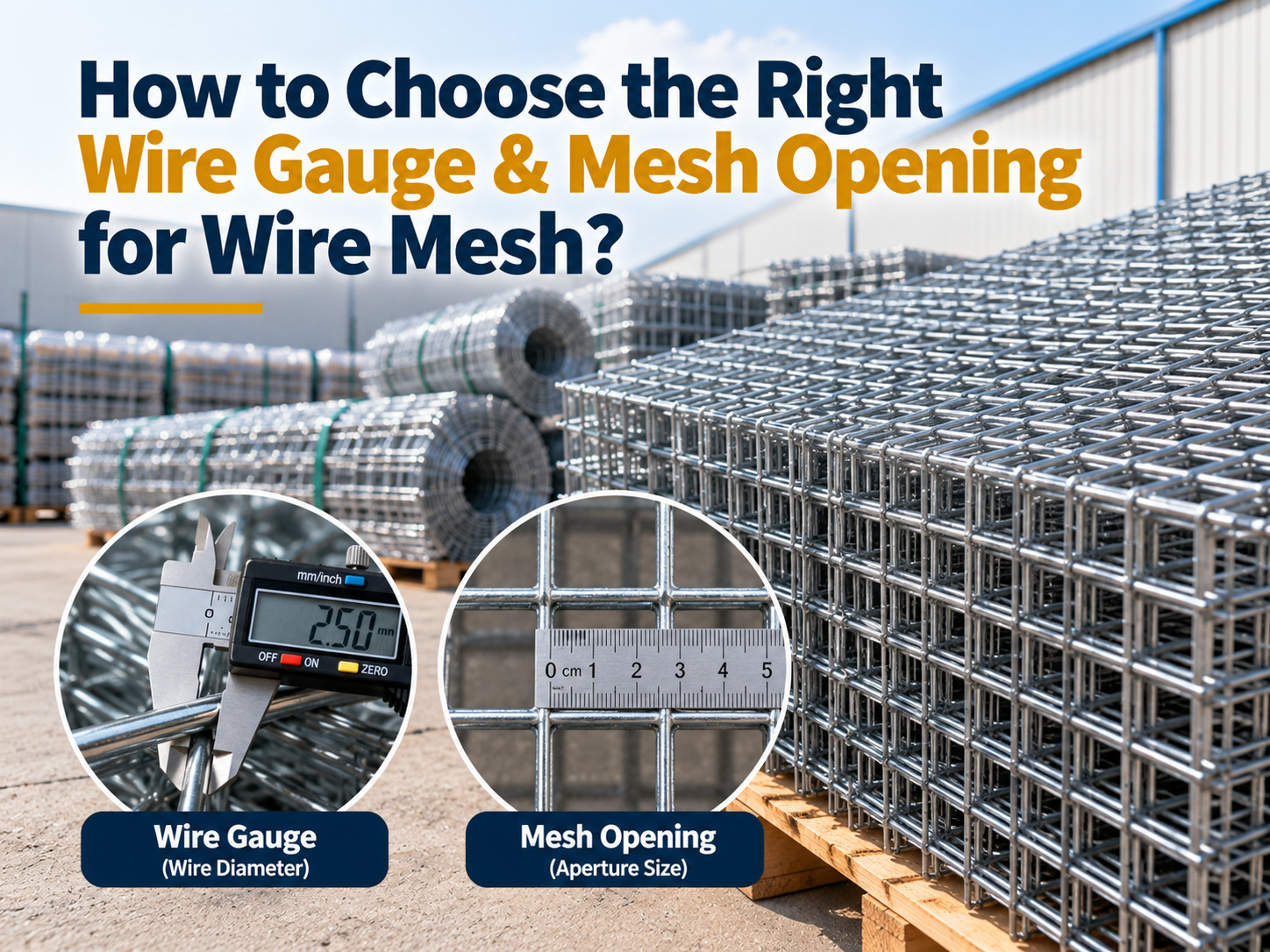
How to Choose the Right Wire Gauge & Mesh Opening for Wire Mesh?
Choosing the wrong wire gauge or mesh opening can turn your construction project into a costly problem. You may spend money on material that cannot handle the required load or does not meet the application's functional needs.
The right wire gauge and mesh opening depend on your application's load requirements, material flow needs, and structural demands. Wire gauge determines strength, while mesh opening controls what can pass through the mesh. Both specifications must match your project requirements.

I've been in the wire mesh manufacturing business for over a decade. During this time, I've seen customers make expensive mistakes simply because they did not fully understand these two critical specifications. This guide explains how wire gauge and mesh opening affect wire mesh selection.
What Do Wire Gauge and Mesh Opening Mean?
Understanding these terms may seem simple, but confusion between wire diameter and mesh opening can lead to incorrect orders, project delays, and unnecessary costs.
Wire Gauge
Wire gauge measures the diameter of the individual wire used to manufacture the mesh. Wire thickness directly affects strength, rigidity, weight, and cost.
Mesh Opening
Mesh opening refers to the clear space between adjacent wires. Opening size determines what can pass through or be contained by the mesh.

Wire gauge follows different measurement systems depending on the market. In the United States, AWG (American Wire Gauge) is commonly used. Under this system, a smaller gauge number indicates a thicker wire. For example, 10 AWG wire is thicker than 14 AWG wire.
Mesh opening can be expressed in inches, millimeters, or mesh count. A 1/2-inch opening means the clear distance between adjacent wires is approximately half an inch. Mesh count works differently: for example, 4 mesh indicates four openings per linear inch.
Common AWG Wire Diameters
| Wire Gauge | Diameter (mm) | Diameter (inches) | Common Applications |
|---|---|---|---|
| 8 AWG | 3.26 | 0.128 | Heavy construction |
| 10 AWG | 2.59 | 0.102 | Structural applications |
| 12 AWG | 2.05 | 0.081 | General construction |
| 14 AWG | 1.63 | 0.064 | Light applications |
Selection Principle: Thicker wire combined with smaller mesh openings generally produces a heavier and stronger mesh, but it also increases material usage, product weight, and cost.
How Do You Convert Wire Gauge to Millimeters?
Conversion between wire gauge systems is especially important in international purchasing. Different countries and suppliers may use AWG, SWG, or metric wire diameters.
Use a standard wire gauge conversion chart when converting between AWG, SWG, and millimeters. For example, 10 AWG is approximately 2.59 mm, 12 AWG is approximately 2.05 mm, and 14 AWG is approximately 1.63 mm.

The AWG system follows a logarithmic scale, so it is safer to use an established conversion table instead of attempting mental conversion. For purchase orders, it is also good practice to include the actual metric diameter.
AWG and SWG Conversion Reference
| AWG | AWG Diameter (mm) | SWG | SWG Diameter (mm) |
|---|---|---|---|
| 8 | 3.26 | 8 | 4.06 |
| 9 | 2.91 | 9 | 3.66 |
| 10 | 2.59 | 10 | 3.25 |
| 11 | 2.30 | 11 | 2.95 |
| 12 | 2.05 | 12 | 2.64 |
| 13 | 1.83 | 13 | 2.34 |
| 14 | 1.63 | 14 | 2.03 |
Buyer Note: AWG and SWG are not interchangeable. When requesting a quotation, clearly state the gauge system or, preferably, provide the required wire diameter in millimeters.
How Do Wire Gauge and Mesh Opening Affect Strength?
The relationship between wire thickness and opening size determines how the mesh behaves under load. Focusing only on price without considering these two variables can result in unsuitable specifications.
Thicker wire provides greater load capacity, while smaller mesh openings increase the number of intersections across a given area. The combination of wire diameter, opening size, material, and welding quality determines overall mesh performance.

Load Distribution Factors
- Wire thickness: Primary factor affecting wire strength.
- Opening size: Influences spacing and stress distribution.
- Intersection density: Smaller spacing produces more intersections over a given area.
- Wire material: Carbon steel and stainless steel have different material properties.
- Coating: Galvanizing improves corrosion protection.
Manufacturing method is another important consideration. Welded wire mesh uses welded intersections to create a relatively rigid grid, while woven mesh allows more movement between individual wires.
What Wire Mesh Thickness Is Suitable for Concrete?
Concrete reinforcement requires careful specification of wire diameter, opening size, and mesh placement. These requirements should be matched to the engineering design of the slab or structure.
The original guide identifies 10–12 AWG wire with 4–6 inch openings as typical for standard residential slab applications, while heavier applications may use thicker wire.

Concrete Application Guidelines
| Application | Wire Gauge | Opening Size | Mesh Position |
|---|---|---|---|
| Sidewalks | 12–14 AWG | 4–6 inches | Upper third |
| Driveways | 10–12 AWG | 4–6 inches | Center |
| Foundations | 8–10 AWG | 4–6 inches | Center |
| Industrial Floors | 8–9 AWG | 4–6 inches | Center |
Project Note: Concrete reinforcement specifications and placement should follow the structural drawings, engineering design, and applicable building standards for the specific project.
How Do You Read Welded Wire Mesh Specifications?
Welded wire mesh specifications often combine spacing and wire size into a short designation. Understanding this format helps buyers avoid ordering the wrong mesh.
Example: 6×6-10/10
In the format described in the original article, 6×6-10/10 means 6-inch spacing in both directions, with 10-gauge wire in both directions.

The first two numbers indicate wire spacing in the longitudinal and transverse directions. The numbers after the dash describe the wire gauge used in each direction.
Common Specification Formats
- 4×4-10/10: 4-inch spacing with 10-gauge wire both ways.
- 6×6-8/8: 6-inch spacing with 8-gauge wire both ways.
- 4×8-10/12: different longitudinal and transverse spacing and wire gauges.
- 6×12-9/12: 6-inch by 12-inch spacing with different wire gauges.
Additional information may also be included, such as coating method, overall roll dimensions, sheet dimensions, or edge requirements.
How Do You Choose the Right Mesh Opening for Your Application?
Mesh opening should be selected according to the smallest object or particle that needs to be retained, or the largest material that must be allowed to pass through.
Smaller openings provide greater containment and screening, while larger openings increase airflow and reduce material usage. The right opening size depends on the application.

Application-Specific Opening Recommendations
| Application | Opening Size | Reasoning |
|---|---|---|
| Concrete Reinforcement | 4–6 inches | Load distribution |
| Security Fencing | 2–3 inches | Security vs. visibility |
| Animal Containment | 1–4 inches | Depends on animal size |
| Debris Screening | 1/4–1 inch | Particle size control |
| Ventilation | 1/2–2 inches | Airflow vs. protection |
Environmental conditions can also affect opening selection. Smaller openings may increase wind resistance, while debris accumulation can become a consideration in some outdoor or corrosive environments.
What Wire Gauge and Mesh Size Should You Choose for Hexagonal Wire Mesh?
Hexagonal wire mesh is constructed differently from welded mesh and is often selected for applications where flexibility and containment are more important than rigidity.
The original guide identifies approximately 19–22 gauge wire with 1/2-inch to 2-inch openings as common for many hexagonal wire mesh applications.

Hexagonal Mesh Application Guide
| Use Case | Wire Gauge | Opening Size | Key Benefit |
|---|---|---|---|
| Chicken Coops | 20 Gauge | 1 inch | Predator protection |
| Garden Protection | 22 Gauge | 1/2 inch | Small pest control |
| Erosion Control | 19 Gauge | 2 inch | Flexible installation |
| Rabbit Fencing | 21 Gauge | 1 inch | Cost-effective containment |
Wire gauge selection for hexagonal mesh requires balancing flexibility with durability. Heavier wire generally provides greater durability, while lighter wire is easier to bend and install.
What Specifications Should You Send to a Wire Mesh Supplier?
Complete technical information helps suppliers understand exactly what you need and reduces the risk of quotation or production errors.
Include wire gauge, actual wire diameter, mesh opening, dimensions, material, coating, edge treatment, quantity, packaging, and applicable standards.

Complete Specification Checklist
- Wire Specifications
Specify wire gauge, actual diameter, material, and coating. - Mesh Parameters
Provide mesh opening dimensions and mesh pattern. - Overall Dimensions
State length, width, sheet size, or roll dimensions. - Product Format
Confirm whether you need rolls, panels, sheets, or custom-cut pieces. - Quantity & Packaging
Provide total quantity and any special packaging requirements. - Standards & Testing
Include relevant compliance standards, certificates, or testing needs. - Delivery Information
Provide required delivery timing, destination, and shipping requirements.
Edge treatment should also be specified when relevant. Raw edges may cost less, while hemmed or finished edges can improve handling and appearance.
Some projects may also require material certificates, mill test reports, compliance documentation, or third-party testing. These requirements should be communicated before production.
Wire Mesh RFQ Checklist
When requesting a quotation from a wire mesh manufacturer, send as much of the following information as possible:
- Wire diameter or gauge
- AWG, SWG, or metric measurement system
- Mesh opening
- Material grade
- Galvanized, PVC-coated, or other surface treatment
- Roll, panel, or sheet dimensions
- Required quantity
- Edge treatment
- Technical standards
- Testing or certification requirements
- Packaging requirements
- Destination and delivery requirements
Conclusion
Selecting the right wire gauge and mesh opening requires understanding the specific requirements of the application, including load demands, containment or filtration needs, operating environment, and project specifications.
Wire diameter determines much of the mesh's mechanical performance, while opening size influences containment, airflow, screening, and material usage. These two specifications should therefore be evaluated together rather than separately.
For international B2B purchasing, clearly identifying the measurement system and providing actual wire diameter in millimeters can also help reduce specification misunderstandings between buyers and suppliers.


